

Category: Sermon

  • Righteousness Is a Gift, Not a Reward

    Righteousness Is a Gift, Not a Reward

    Text: Epistle to the Romans 5:17

    “For if by the one man’s offence death reigned through the one, much more those who receive abundance of grace and of the gift of righteousness will reign in life through the One, Jesus Christ.” (Romans 5:17, NKJV)

    Introduction

    Many people believe that God accepts them because of their good works, religious activities, or moral lifestyle. They try to earn God’s approval through performance. However, the gospel declares something radically different: righteousness is not something we achieve; it is something we receive.

    Romans 5:17 teaches that righteousness is a gift of grace, not a wage for human effort. This truth is at the heart of the gospel and the foundation of victorious Christian living.

    What Is Righteousness?

    Biblically, righteousness means being in a right standing with God. It is being declared just and accepted before God because of Jesus Christ.

    Righteousness is:

    • Right relationship with God.
    • Freedom from condemnation.
    • Acceptance before God.
    • Qualification to approach God confidently.

    I. Righteousness Cannot Be Earned

    Romans 3:20

    “By the deeds of the law no flesh will be justified.”

    No amount of:

    • Prayer
    • Fasting
    • Giving
    • Church attendance
    • Good works

    can make a sinner righteous before God.

    Our best efforts are insufficient.

    Book of Isaiah 64:6

    “All our righteousnesses are like filthy rags.”

    Lesson

    Religion says, “Do more.” The gospel says, “Christ has done it.”

    II. Righteousness Is God’s Gift Through Jesus Christ

    Romans 5:17 calls it “the gift of righteousness.”

    A gift:

    • Cannot be earned.
    • Cannot be bought.
    • Is received by faith.

    Jesus lived the righteous life we could never live and died the death we deserved so that His righteousness could become ours.

    Second Epistle to the Corinthians 5:21

    “He made Him who knew no sin to be sin for us, that we might become the righteousness of God in Him.”

    The great exchange:

    • Jesus took our sin.
    • We receive His righteousness.

    III. Grace Is the Source; Faith Is the Means

    Romans 5:17 mentions:

    • Abundance of grace
    • The gift of righteousness
    • Grace provides the gift.
    • Faith receives the gift.

    Epistle to the Ephesians 2:8–9

    “By grace you have been saved through faith… it is the gift of God.”

    Faith is simply trusting what Christ has accomplished.

    IV. Those Who Receive the Gift Reign in Life

    Romans 5:17 says believers “shall reign in life.”

    This means victory over:

    • Sin
    • Condemnation
    • Fear
    • Satan’s accusations
    • Spiritual defeat

    Because our standing before God depends on Christ—not our performance—we can live with confidence.

    We reign because of who Christ is, not because of who we are outside of Christ.

    V. Rewards Are Different From Gifts

    The Bible distinguishes between salvation and rewards.

    The Gift

    • Given freely.
    • Received by faith.
    • Available to every believer.

    Rewards

    • Given for faithful service.
    • Received after salvation.
    • Based on obedience and stewardship.

    First Epistle to the Corinthians 3:12–15

    Salvation is free.

    Rewards are earned through faithful service.

    Never confuse the two.

    VI. Living From the Gift of Righteousness

    When we know we are righteous in Christ:

    • We pray boldly. Epistle to the Hebrews 4:16
    • We overcome guilt. Epistle to the Romans 8:1
    • We walk in holiness. Holiness becomes the fruit of righteousness—not the price of righteousness.
    • We serve God out of gratitude. Obedience flows from love, not fear.

    Practical Applications

    1. Stop trying to earn God’s acceptance.
    2. Receive His righteousness by faith.
    3. Reject condemnation.
    4. Live confidently as God’s child.
    5. Pursue holiness because you are righteous, not to become righteous.
    6. Serve God with gratitude and joy.

    Conclusion

    The gospel is not about working for righteousness but receiving righteousness through Jesus Christ.

    Religion tells us to climb up to God.

    The gospel tells us that God came down to us through Christ.

    Your righteousness is not based on your past, your performance, or your perfection.

    It is based entirely on Jesus Christ.

    Therefore, receive the abundance of grace and the gift of righteousness, and reign in life through Him.

    Invitation

    If you have never trusted Christ, today is the day to receive God’s free gift of righteousness. Turn from trusting in your own goodness and place your faith in Jesus Christ alone.

    For those who are already believers, stop living under guilt and condemnation. Stand confidently in the righteousness that Christ has freely given you, and live a life that reflects His grace and glory.

    Key Truth: Righteousness is not a reward for the good; it is God’s gracious gift to those who believe in Jesus Christ.
  • Sanctification by Grace

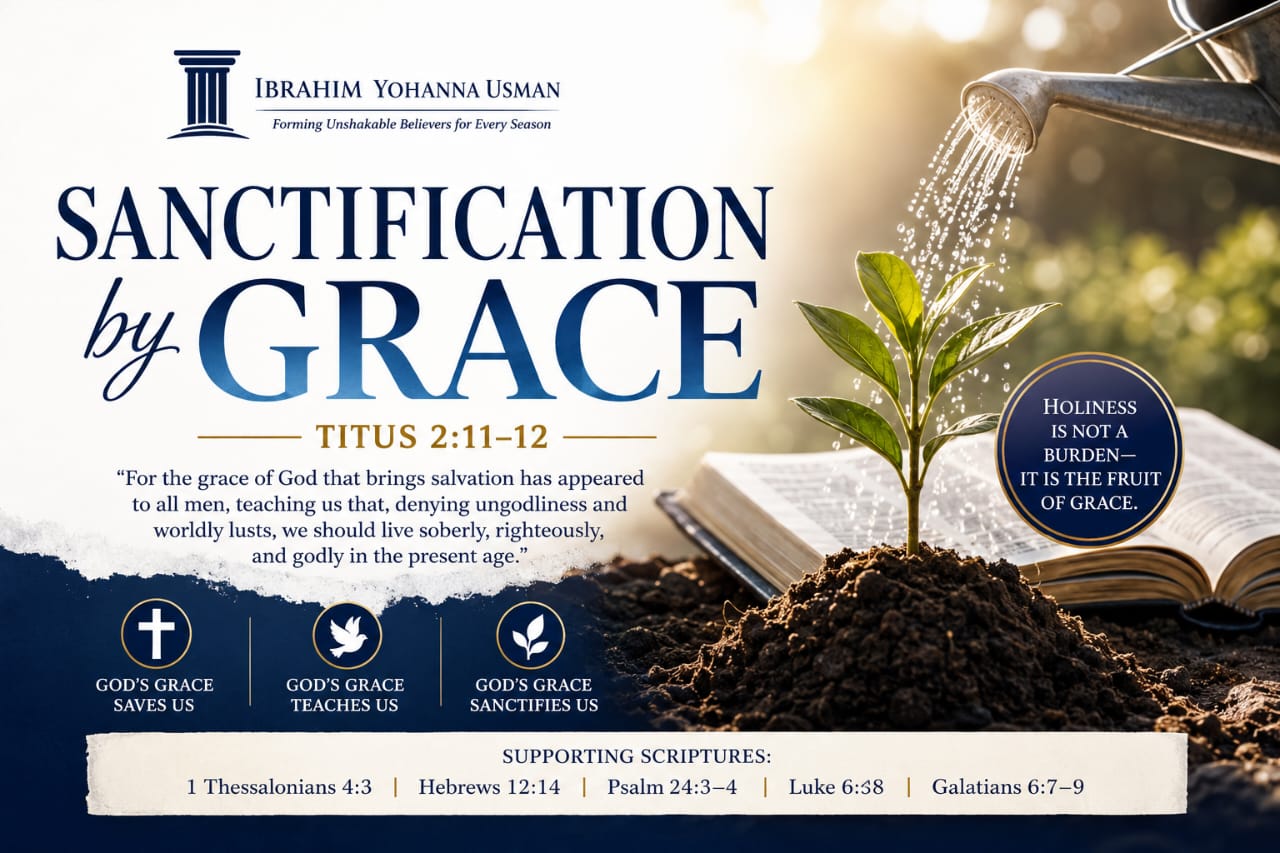
    Sanctification by Grace

    Text: Titus 2:11–12

    Supporting Scriptures: 1 Thessalonians 4:3 • Hebrews 12:14 • Psalm 24:3–4

    Introduction

    One of the greatest misconceptions among Christians is that holiness is achieved by human effort. Many believers struggle to live holy lives because they depend on their own strength instead of God’s grace.The Bible teaches us that holiness is not the price we pay to earn God’s love. Rather, holiness is the evidence that we have already received God’s love and grace.

    God does not make us holy to love us; He makes us holy because He loves us.Grace not only saves us from the penalty of sin; it also delivers us from the power of sin. The same grace that justifies the sinner also sanctifies the believer.

    Titus 2:11–12 tells us that grace is a teacher. It trains us to reject ungodliness and to live lives that please God.

    Scripture Reading

    “For the grace of God that brings salvation has appeared to all men, teaching us that, denying ungodliness and worldly lusts, we should live soberly, righteously, and godly in the present age.”— Titus 2:11–12

    This passage reveals that grace is not permission to continue in sin; grace is God’s power to overcome sin.

    1. Holiness Is God’s Will

    Text: 1 Thessalonians 4:3

    “For this is the will of God, your sanctification…”

    Many believers constantly ask,

    “What is God’s will for my life?”

    Before God reveals His specific will concerning your career, marriage, or ministry, He first reveals His general will—that His children live holy lives.

    Sanctification means being set apart for God.

    • God called Israel to be holy.
    • God called the Church to be holy.
    • God calls every believer today to be holy.

    Holiness is not reserved for pastors, evangelists, or church leaders.It is God’s expectation for every believer.

    What Holiness Is Not

    Holiness is not merely:

    • Wearing certain clothes.
    • Following religious traditions.
    • Avoiding certain foods.
    • Looking spiritually impressive.

    True holiness begins in the heart and transforms every area of life.

    A holy heart produces holy speech, holy thoughts, holy relationships, holy decisions, and holy living.

    2. Grace Empowers Holy Living

    Grace does not lower God’s standard.

    Grace gives us the power to meet God’s standard.

    Many people wrongly believe that grace allows believers to continue living carelessly.

    Paul teaches the opposite.

    • Grace teaches.
    • Grace disciplines.
    • Grace transforms.
    • Grace empowers.

    Without grace, holiness becomes legalism.

    Without holiness, grace becomes cheap.

    The Christian life is not about trying harder.

    It is about surrendering more fully to Christ.

    The Holy Spirit produces holiness as we walk with Him daily.

    Just as fruit grows naturally on a healthy tree, holiness grows naturally in the life of a believer who abides in Christ.

    3. Holiness Enables Intimacy with God

    Text: Hebrews 12:14

    “Pursue peace with all people, and holiness, without which no one will see the Lord.”

    Holiness does not earn God’s presence.

    Holiness prepares us to enjoy God’s presence.

    Psalm 24 asks:

    “Who may ascend into the hill of the Lord?”

    The answer is:

    “He who has clean hands and a pure heart.”

    Sin creates distance.

    Holiness creates fellowship.

    The closer we walk with God, the more His character becomes visible in our lives.

    God desires more than occasional visits.

    He desires daily fellowship.

    4. Sanctification Is a Daily Process

    Salvation happens in a moment.

    Sanctification continues throughout our lives.

    Every day God shapes us into the likeness of Christ.

    Sometimes He uses:

    • His Word
    • Prayer
    • Trials
    • Correction
    • Fellowship with other believers
    • The work of the Holy Spirit

    God is more interested in our character than our comfort.

    Every circumstance becomes an opportunity for Him to make us more like Jesus.

    5. The Evidence of Sanctification

    How do we know we are growing in holiness?

    A sanctified believer demonstrates:

    • Love instead of hatred.
    • Purity instead of compromise.
    • Humility instead of pride.
    • Forgiveness instead of bitterness.
    • Self-control instead of uncontrolled desires.
    • Obedience instead of rebellion.

    The fruit of sanctification is a life that increasingly resembles Christ.

    Practical Application

    How can we cooperate with God’s sanctifying grace?

    1. Desire Holiness
      • Ask God to give you a hunger for righteousness.
    2. Respond to the Holy Spirit’s Correction
      • Do not ignore conviction.Repent quickly whenever God speaks.
    3. Depend Daily on Grace
      • Victory over sin comes through God’s grace, not human strength.
      • Spend time daily in prayer and God’s Word.Walk in obedience to the Holy Spirit.

    Conclusion

    Grace is not an excuse to remain the same.Grace changes us.Grace teaches us.Grace strengthens us.Grace sanctifies us.The God who saved us is also committed to making us holy.

    As we yield ourselves to Him, He transforms us from glory to glory until we become more like Christ.

    May we never resist the work of grace.

    May we pursue holiness with joy.

    May our lives reflect the beauty of Christ to a watching world.

    Closing Prayer

    Heavenly Father,Thank You for the grace that not only saves us but also sanctifies us.

    Purify our hearts.

    Renew our minds.

    Teach us to deny ungodliness and worldly desires.

    Help us to live soberly, righteously, and godly in this present age.

    Fill us daily with Your Holy Spirit and make us more like Jesus.

    Let our lives bring glory to Your holy name.In Jesus’ mighty name we pray. Amen.

  • Growing in the Grace of Giving

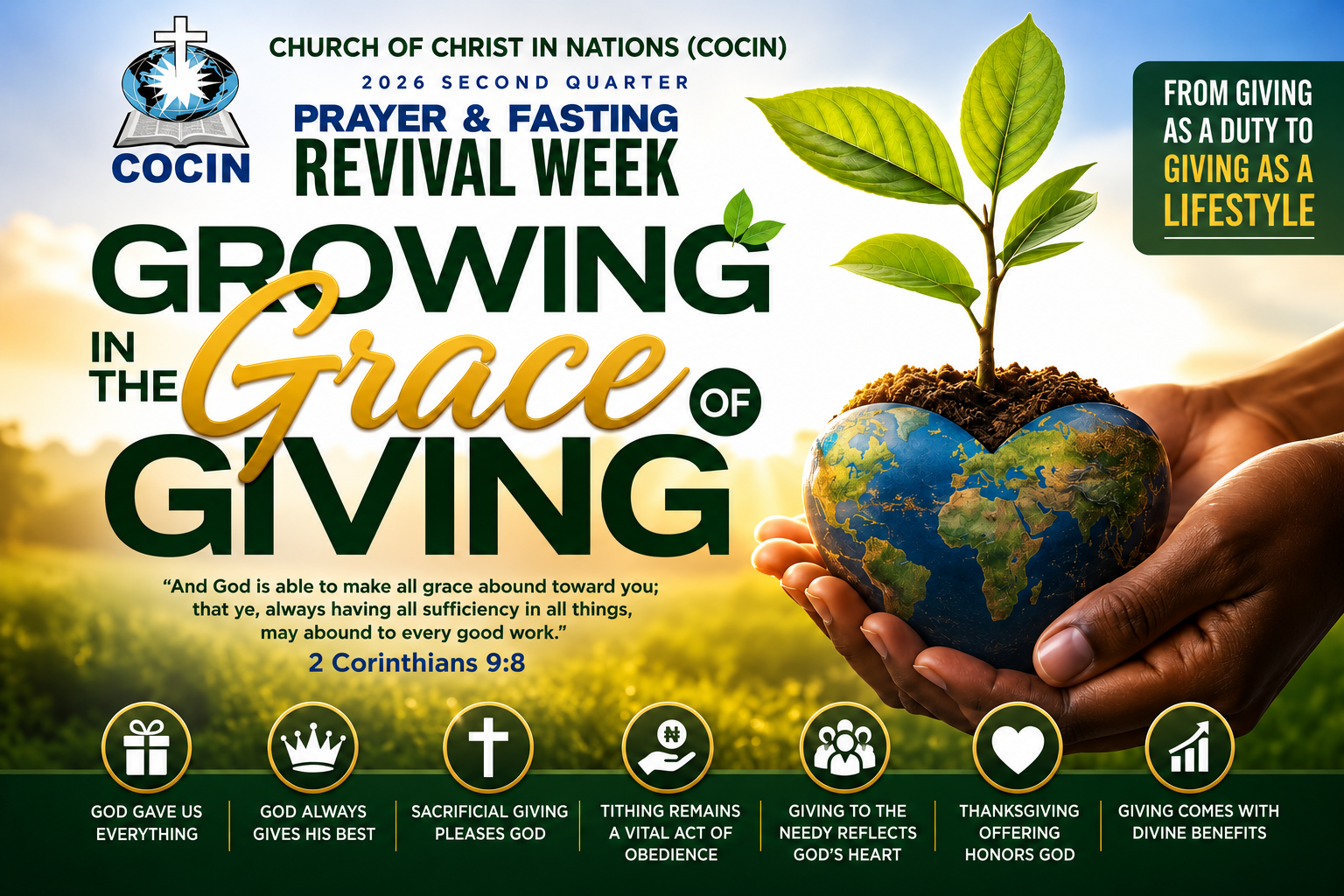
    Growing in the Grace of Giving

    Sermon for the Conclusion of the 2026 Second Quarter Prayer and Fasting Revival Week

    Text: 2 Corinthians 9:6–8

    Supporting Texts: Luke 6:38; Galatians 6:7–9; 1 Corinthians 13:11

    Title:From Giving as a Duty to Giving as a Lifestyle

    Introduction

    Beloved in Christ, we give God all the glory for bringing us to the conclusion of this blessed Revival Week. Throughout this week, God has taken us on a spiritual journey of understanding the grace of giving.

    We have learned that:

    • God gave us everything.
    • God always gives His best.
    • Sacrificial giving pleases God.
    • Tithing remains a vital act of obedience.
    • Giving to the needy reflects God’s heart.
    • Thanksgiving offering honors God.
    • Giving comes with divine benefits.

    Today, we conclude by asking a crucial question:

    Have we merely heard about giving, or have we grown in the grace of giving?

    Paul reminds us in 2 Corinthians 9:8 that God is able to make all grace abound toward us. Giving is not merely a financial activity; it is a grace that must grow within us.

    1. Growth Means Moving from Spiritual Childhood to Spiritual Maturity

    Text: 1 Corinthians 13:11

    “When I was a child, I spoke as a child, I understood as a child… but when I became a man, I put away childish things.”

    One mark of spiritual maturity is generosity.

    • Children always ask, “What can I get?” Mature believers ask, “What can I give?”
    • The immature Christian sees giving as a loss. The mature Christian sees giving as worship.
    • The immature Christian gives only when compelled. The mature Christian gives willingly and cheerfully.

    God is calling COCIN (and all believers) to move from being receivers only to becoming channels of blessing.

    2. Giving Reflects the Character of God

    Text: John 3:16

    “For God so loved the world that He gave…”

    The first thing God did after creating mankind was to give.The greatest thing God ever did for humanity was to give His Son.

    Therefore:

    • Giving is God’s nature.
    • Generosity is God’s language.
    • Sacrifice is God’s pattern.
    • When believers give, they reveal the character of their Heavenly Father.

    The question is not merely whether we give, but whether our giving reflects God’s heart.

    3. Giving Is an Act of Worship

    Text: Exodus 23:25

    Worship the Lord your God, and his blessing will be on your food and water. I will take away disease from among you,

    Our giving is not fundraising alone. Our giving is not a financial transaction. Our giving is worship.

    • Abraham worshipped through sacrifice.
    • David worshipped through costly giving.
    • The widow worshipped through her two mites.
    • The Macedonian believers worshipped through sacrificial generosity.

    Every offering placed before God should say:

    “Lord, I love You. Lord, I trust You. Lord, everything I have belongs to You.”

    4. Giving Activates Kingdom Principles

    Texts: Luke 6:38; Galatians 6:7

    God has established a spiritual law:

    “Give, and it shall be given unto you.”

    The kingdom operates on sowing and reaping.

    • We sow money and reap provision.
    • We sow kindness and reap mercy.
    • We sow service and reap reward.
    • We sow prayers and reap answers.
    • We sow love and reap fellowship.
    • The harvest may not come immediately, but God’s Word never fails.

    Every seed planted in obedience has a harvest attached to it.

    5. The Greatest Gift God Wants Is You

    Before God asks for your money, He asks for your heart.The Macedonians first gave themselves to the Lord (2 Corinthians 8:5).

    Many people give offerings without giving themselves.

    Today God is saying:

    “My son, give me your heart.”

    When God has your heart:

    • Your money follows.
    • Your time follows.
    • Your talents follow.
    • Your service follows.
    • True giving begins with total surrender.

    6. The Benefits of Growing in the Grace of Giving

    God never remains indebted to anyone.

    According to Exodus 23:25–26 and Luke 6:38, the blessings associated with faithful giving include:

    1. Spiritual Benefits
      • Greater intimacy with God
      • Increased faith
      • Joy in serving God
      • Growth in Christlikeness
    2. Physical Benefits
      • Divine provision
      • God’s protection
      • Healing and restoration
      • Fruitfulness and increase
    3. Kingdom Benefits
      • Advancement of the Gospel
      • Care for the needy
      • Growth of the Church
      • Transformation of communities
    4. Eternal Benefits
      • Jesus said: “Lay up for yourselves treasures in heaven.” (Matthew 6:20)

    Every gift given for God’s glory has eternal value.

    Conclusion: Let Us Continue Growing

    As this Revival Week comes to an end, let our growth not end.

    Let us continue:

    • Giving our hearts to God.
    • Giving our tithes faithfully.Giving sacrificially.
    • Giving to the needy.
    • Giving thanksgiving offerings.
    • Giving our talents and time for God’s work.

    May COCIN become known not only as a praying church but also as a generous church.

    • May our homes become generous homes.
    • May our leaders become examples of generosity.
    • May our members abound in every good work.

    Let us leave this Revival Week determined to grow continually in the grace of giving until Christ returns.

    Closing Charge

    “And God is able to make all grace abound toward you; that ye, always having all sufficiency in all things, may abound to every good work.” 2 Corinthians 9:8

    May the Lord enlarge our hearts, increase our faith, multiply our resources, and make us abound in every good work through Christ Jesus. Amen.