Author: ibrahimyohannausman

  • Finishing Well

    Finishing Well

    The Ultimate Victory of Grace

    The “Arrival” at the Park

    If you have ever taken a long-distance bus from Maiduguri to Lagos, you know that the journey is not judged by how “clean” the bus was at the start, or how fast it drove through the North. The only thing that matters to the passengers and the families waiting is: “Did the bus arrive at the park?”

    There were breakdowns, there were police checkpoints, there were rainstorms, and perhaps a flat tire. But as the bus pulls into the terminal and you see your loved ones, the “wahala” of the road begins to fade.

    Life in a fallen world is a long-distance journey. Many people start with fire, but “Nigeria” happens to them. The “System” happens to them. Disappointment happens to them. They become bitter, tired, and eventually, they “park” by the side of the road. But God’s Grace is not just “Starting Fluid”; it is “Finishing Power.” It is the guarantee that the “Good Work” He started in you will be completed.

    The Finisher’s Confidence

    “Being confident of this very thing, that He who has begun a good work in you will complete it until the day of Jesus Christ.” — Philippians 1:6 (NKJV)

    And the words of Paul at the end:

    “I have fought the good fight, I have finished the race, I have kept the faith.” — 2 Timothy 4:7 (NKJV)

    Notice Paul didn’t say, “I won every battle” or “I was always rich.” He said, “I kept the faith.” That is the definition of finishing well.

    From Survival to Sovereignty

    We must make one final shift: moving from seeing ourselves as “Survivors” of adversity to seeing ourselves as “Successors” of the Kingdom.

    • The “Omega” Grace: Jesus is the Alpha (the Beginner) and the Omega (the Finisher). Grace ensures that your middle doesn’t cancel your end.
    • The “Eternal” Perspective: This chapter reminds us that this world is not the “Final Bus Stop.” Grace gives us the “Long View”— the understanding that our “light affliction” is producing an eternal weight of glory.
    • The Grace of Consistency: Finishing well isn’t about one big “jump”; it’s about 10,000 small steps of faithfulness. Grace provides the “daily mercy” for the “daily walk.”

    The Legacy of the “Quiet” Father

    I think of Papa Emeka, a simple man who worked in the Civil Service for 35 years. He never owned a “mansion,” and he never flew in a private jet. He faced the “adversity” of lean salaries and the pressure to take bribes, which he always refused. He suffered through the loss of his wife early in life.

    When Papa Emeka was 80, his children and grandchildren gathered. They weren’t celebrating his “bank balance”; they were celebrating his Unbroken Spirit. He had finished the race with his integrity intact, his love for God burning bright, and his children walking in the way of the Lord. He looked at his pastor and said, “Pastor, I didn’t have much, but I had Grace. And Grace was enough to bring me home.” That is the ultimate victory.

    3 Steps to Ensure a Strong Finish

    1. Keep the “End” in Sight: Every morning, remind yourself: “I am a citizen of Heaven passing through earth.” This stops you from getting too “tangled” in the temporary “wahala” of the world.
    2. Trust the “Author” with the Plot Twists: Your life is a book written by God. Just because the current chapter is “Difficult” doesn’t mean the book is a tragedy. Let the Author finish the story.
    3. Stay in the “Flow” until the End: Don’t retire from God. As long as there is breath in your lungs, there is a purpose for your life. Grace is available for the 80-year-old just as much as for the 18-year-old.

    The Final Prayer

    Father, I thank You for this journey through the pages of Your Grace. I thank You that I am not the same person who started Chapter 1. I receive the “Finishing Grace” for my life, my marriage, my career, and my walk with You. I declare that I will not die in the wilderness. I will not stop at the “Red Sea.” I will not “park” in the cave. I will arrive at the park! I will finish my race with joy and keep the faith until I see You face to face. Amen.
  • The Role of Community – Grace Through the Hands of Others

    The Role of Community – Grace Through the Hands of Others

    The “Esusu” of the Spirit

    In Nigeria, we understand the power of the Esusu or Ajo or Adashe (the rotating contribution). You may not have ₦500,000 today to start a business, but when twenty people put their small amounts together and give it to you this month, you have the “bulk” power to do great things. You are benefiting from a strength that is not your own.

    The Body of Christ is God’s Esusu system. There are days when your “Grace Account” feels empty. You cannot pray, you cannot see the way forward, and your faith is flickering like a “NEPA” light bulb. In those moments, God doesn’t just send an angel from heaven; He sends a brother or sister from the next street. He provides “Proximal Grace”—the grace that reaches you through the hands, words, and pockets of your community. If you try to carry your adversity alone, you are rejecting the very “support beams” God built to hold you up.

    The Roof-Breakers

    “Then they came to Him, bringing a paralytic who was carried by four men. And when they could not come near Him because of the crowd, they uncovered the roof where He was.” — Mark 2:3–4 (NKJV)

    Notice that the paralytic didn’t get to Jesus on his own. He didn’t even have the strength to “claim his healing.” He was carried. His miracle was a “Community Project.”

    From “Privacy” to “Partnership”

    We must shift from “Toxic Privacy” (hiding our pain to protect our pride) to “Gospel Partnership” (sharing our burden to multiply our strength).

    • Grace in the “Assembly”: Hebrews 10:25 warns us not to forsake the gathering of believers. Why? Because when “Two or Three” are gathered, there is a Corporate Grace that is stronger than “Individual Grace.”
    • The “Safety Net”: In the early church (Acts 2), no one was in lack because they shared everything. Community is God’s social security system.
    • Iron Sharpening Iron: Sometimes, the grace you need is a “correction” or a “new perspective” from a mentor. You can’t see the back of your own head; you need someone else to tell you what’s there.

    The “Widow’s Rice”

    I remember a sister in a suburban Lagos parish who lost her husband suddenly. She was left with three kids and a small retail shop that was failing. She was too proud to ask for help, so she stayed home and “prayed in secret.”

    Her “Small Group” (House Fellowship) noticed her absence. They didn’t just send a text; they showed up. When they realized she was eating “white rice” with no stew for days, they didn’t judge her. One brother paid a term’s school fees. Two sisters took turns helping her restock her shop. She told her pastor later, “Pastor, I was waiting for God to drop manna from the sky, but He sent mannathrough the ‘Fellowship Bus.’” The grace she received wasn’t just money; it was the realization that she was not alone in the world.

    3 Steps to Tap into Community

    1. Lower Your Guard: Pride is the enemy of community grace. If you are struggling, tell someone you trust. You don’t need to tell the whole world, but you need to tell your “Four Men” (your inner circle).
    2. Join a “Small Group”: You cannot find community in a crowd of 5,000 people on Sunday morning. You find it in the “House Fellowship,” the “Department,” or the “Cell Group.” That is where “Carrying” happens.
    3. Be a “Carrier” for Someone Else: Don’t just look for who will help you. Look for whose “roof” you can help break. When you become a channel of grace for others, you automatically live in the “Flow” of grace yourself.

    The Prayer of Activation

    Lord, I thank You that You did not design me to be an island. I repent for the pride that made me hide my struggles. I thank You for the “Body of Christ” and the family You have placed me in. I receive the humility to be “carried” when I am weak, and I receive the strength to “carry” others when I am strong. Let Your grace flow through my community to keep us all standing. Amen.

  • Living with Resilience

    Living with Resilience

    Building a “Shock-Resistant” Faith

    The “Ikeja Pothole” Lesson

    If you drive in Lagos, you know that the “Road to Success” is literally filled with potholes. You can have a brand-new car, but if your shock absorbers are worn out, a single trip to the mainland will leave your bones aching and your car in the mechanic’s shop. A car without resilience makes every bump feel like an earthquake.

    Many Christians have “High-Performance” faith when things are smooth, but they have zero “Shock Absorbers.” The moment a “pothole” appears—a delayed salary, a misunderstanding with a spouse, or a sudden “No” from a benefactor—their whole spiritual life rattles. They stop coming to church, they stop reading the Word, and they start questioning God.

    Resilience is the “Ijeoma” (Good Journey) Grace. It is the ability to hit a bump and keep moving without the car falling apart. It doesn’t mean you don’t feel the bump; it means you have the Internal Capacity to absorb the shock.

    The House on the Rock

    “And the rain descended, the floods came, and the winds blew and beat on that house; and it did not fall, for it was founded on the rock.” — Matthew 7:25 (NKJV)

    Notice that the rain, the floods, and the winds beat on both houses—the one that stood and the one that fell. The difference wasn’t the “Adversity” (the storm); the difference was the Foundation (the Resilience).

    From Fragile to “Antifragile”

    There is a concept called “Antifragility.” Something is fragile if it breaks under stress. It is resilient if it resists breaking. But it is Antifragile if it actually gets stronger because of the stress. Grace makes the Nigerian believer antifragile.

    • Resilience is a “Muscle,” not a “Wish”: You don’t get resilience by praying for it; you get it by exercising your faith during small trials so you are ready for the big ones.
    • Grace as “Spiritual Reinforcement”: Like the iron rods (REBAR) used in the pillars of a Lagos skyscraper, Grace is the “hidden strength” inside your character that holds you up when the wind of the economy blows.
    • The “Bounce Back” Factor: Proverbs 24:16 says the righteous man falls seven times and rises again. Resilience is the grace to keep getting back up.

    The “Unstoppable” Trader

    I think of Mama Tunde, who sold lace fabrics in Balogun Market. Over thirty years, she saw it all: the market fires of the early 2000s, the various currency devaluations, and the death of her business partner. Each time, people thought she was “finished.”

    But Mama Tunde had a “Resilient Grace.” After the fire, she started selling from a small “attachment” on the street. After the devaluation, she switched to a more affordable line of fabrics. When asked her secret, she laughed and said, “Pastor, I am like the ‘pako’ (chewing stick). You can try to break me, but I will only bend and then snap back. My God is my Shock Absorber.” She didn’t just survive the “Nigerian Factor”; she used the challenges to learn how to pivot.

    3 Steps to Build Your “Shock Absorbers”

    1. Build Your “Word-Foundation”: You cannot build resilience on “Daily Devotional Crumbs.” You need the “Solid Meat” of the Word. Study the promises of God until they become part of your “System.” When the storm hits, you shouldn’t be looking for your Bible; the Bible should be looking out through your eyes.
    2. Practice “Small” Trust: Don’t wait for a major crisis to trust God. Trust Him for your daily transport fare. Trust Him to handle a “stubborn” colleague. These “small wins” build the “muscle memory” of resilience.
    3. Check Your “Company”: If you hang around “NFA” (No Future Ambition) people who only complain about Nigeria, your resilience will drain. Surround yourself with “RockBuilders”—people who see the storm but trust the Anchor.

    The Prayer of Activation

    Lord, I thank You that I am not “Fragile.” I am built on the Rock. I receive the Grace of Resilience today. Strengthen my internal “Shock Absorbers.” When the winds of adversity blow, I declare that I shall not be moved. I receive the “Antifragile” Grace to get better and stronger through every challenge. I may be pressed, but I am not crushed! Amen.

  • Forgiving the”Human Tools” of Adversity

    Forgiving the”Human Tools” of Adversity

    The Grace to Release the Debt

    The “Boli” (Roasted Plantain) Analogy

    Imagine you are holding a piece of hot boli straight from the charcoal fire. It is burning your palm, the heat is blistering your skin, and you are crying out in pain. A friend sees you and shouts, “Drop it!” But you reply, “No! I won’t drop it until the person who put it in my hand apologizes!”

    That sounds foolish, doesn’t it? Yet, that is exactly how we handle unforgiveness. We hold onto the burning coal of resentment—the betrayal of a business partner, the cruelty of an in-law, the “longthroat” of a relative who stole an inheritance—and we refuse to let go because we want “justice.” We think that by staying angry, we are punishing the other person.

    The truth is, unforgiveness is like drinking “sniper” and expecting the other person to die. In the Nigerian environment, where “wickedness” can be very intentional, the grace to forgive isn’t just a “nice” religious idea; it is a spiritual emergency.

    The Vertical and Horizontal Flow

    “And forgive us our debts, as we forgive our debtors.” —Matthew 6:12 (NKJV)

    Also:

    “Be kind to one another, tenderhearted, forgiving one another, even as God in Christ forgave you.” — Ephesians 4:32 (NKJV)

    Notice that the grace to forgive doesn’t come from your “good heart.” It comes from the Vertical Flow (God to you) spilling over into the Horizontal Flow (you to others). You don’t forgive because they deserve it; you forgive because you have been forgiven.

    From Judge to Trustee

    We must shift our role from being the Judge (trying to sentence our enemies) to being the Trustee (handing the case over to the Higher Court).

    • Forgiveness is Not “Approving” the Sin: Forgiving the “Haman” who tried to ruin you doesn’t mean what they did was okay. It means you are refusing to let their “wickedness” dictate your “wellness.”
    • The “Debt” Release: In the Greek, to forgive means “to let go” or “to send away.” It’s like canceling a ₦5,000,000 debt. You acknowledge the debt was real, but you decide you are no longer going to spend your life trying to collect it.
    • Vengeance is a “Heavy Load”: When you try to take revenge, you are doing God’s job, and you don’t have the “Grace Capacity” for it. It will break your health and block your prayers.

    The Land Dispute

    I remember a man named Elder Joseph. His younger brother, through “juju” and false documents, took over their father’s choice landed property in Lagos. For ten years, Elder Joseph was in court. He was bitter. His blood pressure was high. He stopped sleeping. His “amen” in church was weak because he was always thinking of his brother’s “downfall.”

    One day, during a communion service, he felt the Holy Spirit whisper: “Joseph, give me the land.” He didn’t mean give the land to the brother, but to release the right to be angry about it. Elder Joseph stopped the court case. He told his brother, “The land is yours. I have God.” Six months later, a company approached Elder Joseph to buy a “small, useless” plot of land he owned in a remote area—that area had just been designated as a Free Trade Zone. He sold it for ten times the value of the land he “lost.” By letting go of the “hot boli,” he opened his hands to receive a feast.

    3 Steps to Forgive the Unforgivable

    1. Acknowledge the Pain: Don’t say “It’s nothing” when it is “something.” Tell God: “Lord, what they did was wicked and it hurt me deeply.” Grace works in the light of truth.
    2. Separate the Person from the “Tool”: Remember that often, people are just “tools” used by the enemy or by their own brokenness. Like Jesus on the cross, say: “Father, forgive them, for they know not what they do.”
    3. The “Transfer” Prayer: Whenever the memory of the betrayal comes back to make you angry, say: “I have released that debt. I have handed that person over to God.” Do this as many times as it takes until the “heat” leaves the memory.

    The Prayer of Activation

    Father, I thank You for the Grace that covered my own sins. Today, I choose to be a channel of that same Grace. I name [Name the person] before You. I release them from the debt of my anger. I refuse to be their judge any longer. I hand the “justice” of this situation over to You, the Righteous Judge. I choose to be free. I choose to move forward. My heart is no longer a prison for my enemies. Amen.

  • Serving God While Hurting

    Serving God While Hurting

    The Ministry of the Wounded Vessel

    The “Doctor” Who is Also Ill

    Imagine walking into a hospital in Ibadan, and as the doctor is prescribing medicine for your malaria, you notice he is also shivering and sipping warm water. Or imagine a woman whose own children are struggling to pay school fees, yet she is the one organizing a food drive for the orphans in her street.

    Our natural instinct is to “hide” until we are healed. We say, “Let me solve my own ‘wahala’ first before I look at another person’s problem.” We feel that if we serve while hurting, we are hypocrites. But in the Kingdom of God, brokenness is a qualification, not a disqualification. Grace allows you to be a “conduit” even when you feel like a “broken pipe.” When you serve from your pain, your ministry has a “weight” that a comfortable person can never replicate.

    Comfort for the Comforter

    “Who comforts us in all our tribulation, that we may be able to comfort those who are in any trouble, with the comfort with which we ourselves are comforted by God.” — 2 Corinthians 1:4 (NKJV)

    Notice the sequence: God comforts us in our trouble (not just after it), so that we can immediately turn around and help someone else. Your “current” struggle is actually your “current” credentials for ministry.

    From Reservoir to Channel

    We must shift from being a Reservoir (trying to collect enough grace just for ourselves) to being a Channel (letting grace flow through us to others).

    • Service as a “Distraction” from Self-Pity: When you focus on someone else’s pain, the “volume” of your own pain is naturally turned down. Grace uses service as a therapeutic tool for your own heart.
    • The “Widow of Zarephath” Principle: She had only one meal left for herself and her son. But when she used that “last bit” to serve the Prophet, her supply became supernatural. Sometimes, the key to your “breakthrough” is hidden in your “service” to someone else’s need.
    • Authority in the Scars: People don’t want to hear from someone who has never struggled. They want to hear from the person who is “limping” but still “walking.” Your scars give you the “moral right” to tell someone else that God is faithful.

    The “Mother of Many”

    I heard of a sister named Uche. For fifteen years, she dealt with the “adversity of the empty womb.” In our society, the pressure on a childless woman is immense. She was insulted by her in-laws and pitied by her neighbors. She had every reason to stay in her room and “fast for her own miracle” every day.

    Instead, Uche started a “Children’s Bible Club” in her compound. She poured her love into other people’s children. She became the “spiritual mother” to every teenager in the neighborhood. One day, a visitor asked her, “How can you play with these children so happily when you don’t have your own?” She replied, “The grace that sustains me is enough to share.” Uche eventually had her own children, but she says the most “powerful” years of her life were the years she served while she was “empty.”

    3 Steps to Serve Through the Ache

    1. Look for Someone “One Step Behind” You: You don’t need to be at the “finish line” to help someone. If you have survived Day 1 of grief, you can help someone who is on Day 0. If you have managed ₦1,000 to last a week, you can give a “tip” to someone who has nothing.
    2. Identify Your “Grace-Gift”: What is the one thing you can still do even when you are tired? Can you listen? Can you pray? Can you send an encouraging WhatsApp message? Do that “one thing” for someone else today.
    3. Don’t Wait for “Perfect” Feelings: If you wait until you “feel like it,” you will never serve. Service is an act of the will supported by Grace. Tell God: “Lord, I am hurting, but use my hands to heal someone else today.”

    The Prayer of Activation

    Lord, I thank You that my “brokenness” is not a waste. I refuse to let my pain turn me inward and make me selfish. I offer my “wounded heart” to You as a vessel. Even as I wait for my own deliverance, give me the grace to be a deliverer for someone else. Let Your comfort flow through me to my neighbors, my colleagues, and my family. I declare that as I water others, I shall also be watered. Amen.

  • Praising God in the Storm

    Praising God in the Storm

    Worship as Spiritual Warfare

    The Bitter Soup

    There is a way we Nigerians handle a “bitter” situation. When things are hard, we often say, “Life has given me bitter leaf soup.”Our natural reaction to bitterness is to complain, to “hiss,” or to sit in silence. We feel that praise is a “luxury” reserved for the day of the wedding, the day of the child dedication, or the day the contract is signed. We think of worship as a Response to a blessing.

    But Grace teaches us that praise is actually a Strategy for the battle.

    Imagine a woman in a busy market in Onitsha. Her goods were seized, her shop is closed, and she is sitting on a wooden stool. Instead of crying, she begins to hum a chorus: “You are God from beginning to the end, there is no place for argument…” People look at her like she is losing her mind. But she isn’t losing her mind; she is releasing her Grace. She is using praise to change the atmosphere before the situation even changes.

    The Midnight Concert

    “But at midnight Paul and Silas were praying and singing hymns to God, and the prisoners were listening to them. Suddenly there was a great earthquake, so that the foundations of the prison were shaken; and immediately all the doors were opened and everyone’s chains were loosed.” — Acts 16:25–26 (NKJV)

    Notice the timing: Midnight. Their backs were bleeding from the whip, their feet were in stocks, and they were in the “inner prison”—the darkest part. They didn’t praise God after the earthquake; they praised Him until the earthquake happened.

    From Feeling to Focus

    We must shift from “Emotional Praise” (singing because we feel good) to “Sacrificial Praise” (singing because God is good).

    • Praise as a “Confused” Weapon: In 2 Chronicles 20, when King Jehoshaphat put the singers at the front of the army, the Bible says God set “ambushments” against the enemy. When you praise in adversity, you confuse the “village people” and the spirits of depression. They expect you to cry; when you sing, their power over your mind is broken.
    • Grace in the “High Praises”: Psalm 22:3 says God “inhabits” the praises of His people. When you praise, you create a “Guest Room” for God in the middle of your mess.
    • The Sacrifice of Praise: Hebrews 13:15 calls it a “sacrifice.” It’s a sacrifice because it costs you something—it costs you your “right” to be grumpy and your “right” to be anxious.

    The “Praise” in the Bus Queue

    I remember a brother named Kayode during a particularly bad season of fuel scarcity and inflation. His car had broken down, his business was slow, and he had been standing in the sun for hours just to get a public bus. He was sweating, and people around him were cursing the government and “blaming everyone.”

    Kayode felt the “heaviness” coming on him. Instead of joining the cursing, he put on his earphones and started listening to a heavy “Highlife” worship medley. Right there at the bus stop, he started tapping his feet and whispering, “Ese o, Baba” (Thank You, Father).

    A man standing next to him asked, “My friend, why are you smiling? Don’t you see how the country is?” Kayode replied, “The country is hard, but my God is higher.” That small act of praise gave him the “mental oxygen” to think clearly. That same evening, he got a call for a job he had forgotten he applied for. The praise didn’t “buy” the miracle, but it positioned him to receive it.

    3 Steps to Praise Through the Pain

    1. Start with “Thank You” for the Basics: When you can’t find a reason to praise God for your “destiny,” praise Him for your “lungs.” If you can breathe, you can praise. Start with the “small” things: life, a roof, a plate of food.
    2. Create a “Warfare Playlist”: Don’t listen to “sad” or “slow” songs that make you want to sleep and cry. Listen to songs that declare the Greatness of God. Use the “Agape” or “Old School” choruses that remind you of God’s faithfulness.
    3. Use Your Body: Even if you don’t feel like “shouting,” lift your hands. The physical act of lifting your hands is a sign of surrender to God and a sign of victory over the enemy. Grace flows when the “hands” are up.

    The Prayer of Activation

    Lord, I refuse to let this storm silence my song. I recognize that You are still on the throne even when my life is in a “go-slow.” Today, I offer You a sacrifice of praise. I praise You because You are bigger than the economy, bigger than my health report, and bigger than my fears. I declare that as I praise You, my chains are loosing, and my prison doors are opening. I inhabit Your peace right now. Amen.

  • Praying Through Adversity

    Praying Through Adversity

    From “Fire for Fire” to “Face to Face”

    The “Warfare” Fatigue

    If you walk through any residential street in Christian dominated city of Nigeria at 5:00 AM, you will hear it: the sound of “Warfare.” We are a people who know how to “command the morning.” We pray with sweat, with high volume, and with “Holy Ghost Fire” for every mountain. We’ve been taught that if you don’t shout, the “village people” won’t hear, and if you don’t sweat, the prayer isn’t “hot.”

    But what do you do when the adversity has sucked the “shout” out of you? What happens when you are so burdened, so heartbroken, or so physically weak that you can’t even stand up, let alone pace the room for three hours?Many Nigerian Christians feel guilty when they can’t perform “High-Octane” prayer. They think, “Because I cannot scream ‘Die by Fire’ today, my enemies will win.” But Grace introduces us to a different kind of communication—one that doesn’t depend on your decibel level, but on your Spirit-to-Spirit connection.

    The Silent Cry

    “Likewise the Spirit also helps in our weaknesses. For we do not know what we should pray for as we ought, but the Spirit Himself makes intercession for us with groanings which cannot be uttered.” — Romans 8:26 (NKJV)

    Consider also Hannah in 1 Samuel 1. She was in deep adversity, mocked by her rival, and “bitter of soul.” When she went to the temple, she wasn’t shouting. Her lips were moving, but no sound was heard. The priest even thought she was drunk! But she was praying from a place of Grace-filled Honesty. God heard her “whisper” clearer than many “shouts.”

    From Performance to Presence

    In a season of adversity, your prayer life must shift from a “Religious Performance” (trying to impress God or scare the devil) to an “Authentic Presence” (resting in God).

    1. Grace Permits Honesty: You don’t have to use “Thee” and “Thou” or “Big Grammar.” Grace says you can tell God, “Lord, I am angry,” or “Father, I am scared.” He already knows; He’s just waiting for you to trust Him with the truth.
    2. The Spirit as the “Assistant”: When your “engine” knocks and you can’t pray, Grace provides the Holy Spirit to “jumpstart” your spirit. Even a groan is a prayer when it’s directed at the Father.
    3. Prayer as “Reception,” Not Just “Transmission”: In adversity, we spend 90% of the time telling God our problems. Grace-filled prayer spends 50% of the time listening for His peace.

    The Prayer of the “Broken” Brother

    I remember Brother Segun, a man known for his “Thunderous” prayers in the men’s fellowship. He lost his only daughter in a tragic accident. For months, Segun couldn’t pray. Every time he opened his mouth, he just cried. He told his pastor, “Pastor, I feel like a backslider. I can’t even say ‘Praise the Lord’ anymore.”

    His pastor told him, “Segun, your tears are liquid prayers.” He started sitting in his living room, just playing soft worship music and saying, “Abba, help me.” That was it. No “fire,” no “shouting.” Months later, he told his pastor that those “quiet” months werewhen he felt God’s presence more than all the years he spent shouting in church. Grace met him in the silence.

    3 Steps to Pray When You’re Weak

    1. Use the “Psalms of Lament”: When you don’t have words, use God’s words. Read Psalm 13, Psalm 23, or Psalm 42 aloud. Let David’s honesty become your “script.”
    2. The “Five-Minute” Rule: If you are overwhelmed, don’t try to pray for an hour. Give God five minutes of “Total Honesty.” Quality of heart beats quantity of time in the school of Grace.
    3. Pray the “Word,” Not the “Problem”: Instead of spending 30 minutes describing how bad the “economy” is (God knows!), spend that time declaring what the Word says about your provision. Turn the scripture into a conversation.

    The Prayer of Activation

    Father, I thank You that You are not a “Taskmaster” who demands a loud performance. I thank You that You hear the whispers of the broken-hearted. Today, I lay down the burden of “performing” my prayers. Holy Spirit, help my weakness. Pray through me when I have no words. I choose to be honest with You about my pain, my fear, and my exhaustion. I receive the peace that comes from just sitting in Your presence. Amen.

  • Righteousness Is a Gift, Not a Reward

    Righteousness Is a Gift, Not a Reward

    Text: Epistle to the Romans 5:17

    “For if by the one man’s offence death reigned through the one, much more those who receive abundance of grace and of the gift of righteousness will reign in life through the One, Jesus Christ.” (Romans 5:17, NKJV)

    Introduction

    Many people believe that God accepts them because of their good works, religious activities, or moral lifestyle. They try to earn God’s approval through performance. However, the gospel declares something radically different: righteousness is not something we achieve; it is something we receive.

    Romans 5:17 teaches that righteousness is a gift of grace, not a wage for human effort. This truth is at the heart of the gospel and the foundation of victorious Christian living.

    What Is Righteousness?

    Biblically, righteousness means being in a right standing with God. It is being declared just and accepted before God because of Jesus Christ.

    Righteousness is:

    • Right relationship with God.
    • Freedom from condemnation.
    • Acceptance before God.
    • Qualification to approach God confidently.

    I. Righteousness Cannot Be Earned

    Romans 3:20

    “By the deeds of the law no flesh will be justified.”

    No amount of:

    • Prayer
    • Fasting
    • Giving
    • Church attendance
    • Good works

    can make a sinner righteous before God.

    Our best efforts are insufficient.

    Book of Isaiah 64:6

    “All our righteousnesses are like filthy rags.”

    Lesson

    Religion says, “Do more.” The gospel says, “Christ has done it.”

    II. Righteousness Is God’s Gift Through Jesus Christ

    Romans 5:17 calls it “the gift of righteousness.”

    A gift:

    • Cannot be earned.
    • Cannot be bought.
    • Is received by faith.

    Jesus lived the righteous life we could never live and died the death we deserved so that His righteousness could become ours.

    Second Epistle to the Corinthians 5:21

    “He made Him who knew no sin to be sin for us, that we might become the righteousness of God in Him.”

    The great exchange:

    • Jesus took our sin.
    • We receive His righteousness.

    III. Grace Is the Source; Faith Is the Means

    Romans 5:17 mentions:

    • Abundance of grace
    • The gift of righteousness
    • Grace provides the gift.
    • Faith receives the gift.

    Epistle to the Ephesians 2:8–9

    “By grace you have been saved through faith… it is the gift of God.”

    Faith is simply trusting what Christ has accomplished.

    IV. Those Who Receive the Gift Reign in Life

    Romans 5:17 says believers “shall reign in life.”

    This means victory over:

    • Sin
    • Condemnation
    • Fear
    • Satan’s accusations
    • Spiritual defeat

    Because our standing before God depends on Christ—not our performance—we can live with confidence.

    We reign because of who Christ is, not because of who we are outside of Christ.

    V. Rewards Are Different From Gifts

    The Bible distinguishes between salvation and rewards.

    The Gift

    • Given freely.
    • Received by faith.
    • Available to every believer.

    Rewards

    • Given for faithful service.
    • Received after salvation.
    • Based on obedience and stewardship.

    First Epistle to the Corinthians 3:12–15

    Salvation is free.

    Rewards are earned through faithful service.

    Never confuse the two.

    VI. Living From the Gift of Righteousness

    When we know we are righteous in Christ:

    • We pray boldly. Epistle to the Hebrews 4:16
    • We overcome guilt. Epistle to the Romans 8:1
    • We walk in holiness. Holiness becomes the fruit of righteousness—not the price of righteousness.
    • We serve God out of gratitude. Obedience flows from love, not fear.

    Practical Applications

    1. Stop trying to earn God’s acceptance.
    2. Receive His righteousness by faith.
    3. Reject condemnation.
    4. Live confidently as God’s child.
    5. Pursue holiness because you are righteous, not to become righteous.
    6. Serve God with gratitude and joy.

    Conclusion

    The gospel is not about working for righteousness but receiving righteousness through Jesus Christ.

    Religion tells us to climb up to God.

    The gospel tells us that God came down to us through Christ.

    Your righteousness is not based on your past, your performance, or your perfection.

    It is based entirely on Jesus Christ.

    Therefore, receive the abundance of grace and the gift of righteousness, and reign in life through Him.

    Invitation

    If you have never trusted Christ, today is the day to receive God’s free gift of righteousness. Turn from trusting in your own goodness and place your faith in Jesus Christ alone.

    For those who are already believers, stop living under guilt and condemnation. Stand confidently in the righteousness that Christ has freely given you, and live a life that reflects His grace and glory.

    Key Truth: Righteousness is not a reward for the good; it is God’s gracious gift to those who believe in Jesus Christ.

  • Walking by Faith, Not by Sight

    Walking by Faith, Not by Sight

    Trusting God When the “Alert” Hasn’t Entered

    The “I Am Expecting” Season

    In Nigeria, we have a way of speaking. When a woman is pregnant, we say, “She is expecting.” We don’t see the baby yet, but we see the signs. We see the bump, we see the change in her walk, and we see her buying baby clothes. She doesn’t wait to see the child’s face before she prepares the room.

    But for many of us, when it comes to our “Financial Expectation” or our “Healing Expectation,” we want to see the “Credit Alert” on our phone before we believe God has moved. We are “Sight-Walkers.” If the dollar rate goes up, our faith goes down. If the news is bad, our spirit is crushed. We are like people trying to drive through a thick “Harmattan” fog on the Shagamu-Benin expressway—because we can’t see the road five meters ahead, we freeze in fear.

    Walking by faith means having the grace to drive through the fog because you trust the Map-Maker more than your own eyes.

    The Faith Definition

    “For we walk by faith, not by sight.” — 2 Corinthians 5:7 (NKJV)

    And also:

    “Now faith is the substance of things hoped for, the evidence of things not seen.” — Hebrews 11:1 (NKJV)

    Notice that faith is called “Substance” and “Evidence.” In a Nigerian court, you cannot win a case without evidence. Grace gives you a “Spiritual Evidence” that is more real than the “Bank Statement” in your hand.

    From Reality to Truth

    There is a difference between Reality (what you see) and Truth (what God says).

    • Sight sees the Potholes; Faith sees the Destination: Sight says, “The economy is bad.” Faith says, “My God shall supply all my needs according to His riches in glory.”
    • Grace as a “Third Eye”: Grace gives you the ability to look at your problem but look through it to the God who is bigger than the problem.
    • The Peace of the “Process”: Walking by faith isn’t just about getting the result; it’s about the peace you have while you are waiting for the result. It is the grace to be “calm in the go-slow.”

    The “Invisible” Job

    I remember a young man named Tosin. He had been “expecting” a job offer from a multinational firm for months. He had passed all the interviews, but the “Appointment Letter” was delayed. His friends started mocking him, telling him to go and find “something else” to do.

    One Sunday, during a testimony session, Tosin stood up. He didn’t have the job yet, but he stood up to thank God for the “Successful Career” he was about to start. People thought he was joking. He said, “The letter hasn’t entered my email, but it has entered my spirit.” Two weeks later, not only did the letter arrive, but the salary was 20% higher than the original offer because of a new company-wide adjustment. Tosin was walking by faith while everyone else was walking by “Rumor.”

    3 Steps to Walk in the Fog

    1. Audit Your “Information Intake”: If you spend 5 hours on social media reading about how “Nigeria is finished” and only 5 minutes in the Word, your “Sight” will always win. Feed your faith, and your doubts will starve to death.
    2. Speak the “Evidence”: Don’t describe your “Sight”; declare your “Faith.” Instead of saying, “Things are hard,” say, “The grace of God is making a way for me where there seems to be no way.”
    3. Act “As If”: If you are believing God for a business, start writing the business plan. If you are believing for healing, start taking small walks. Grace meets you in action, not just in “wishing.”

    The Prayer of Activation

    Lord, I repent for being a “Sight-Walker.” I repent for letting the news, the economy, and my bank balance dictate my joy. Today, I receive the “Third Eye” of Grace. I choose to believe Your Truth over my Reality. I declare that even though I don’t see the way out yet, I trust the Way-Maker. I walk into this day with a “Holy Confidence,” knowing that my evidence is in Your Word. Amen.

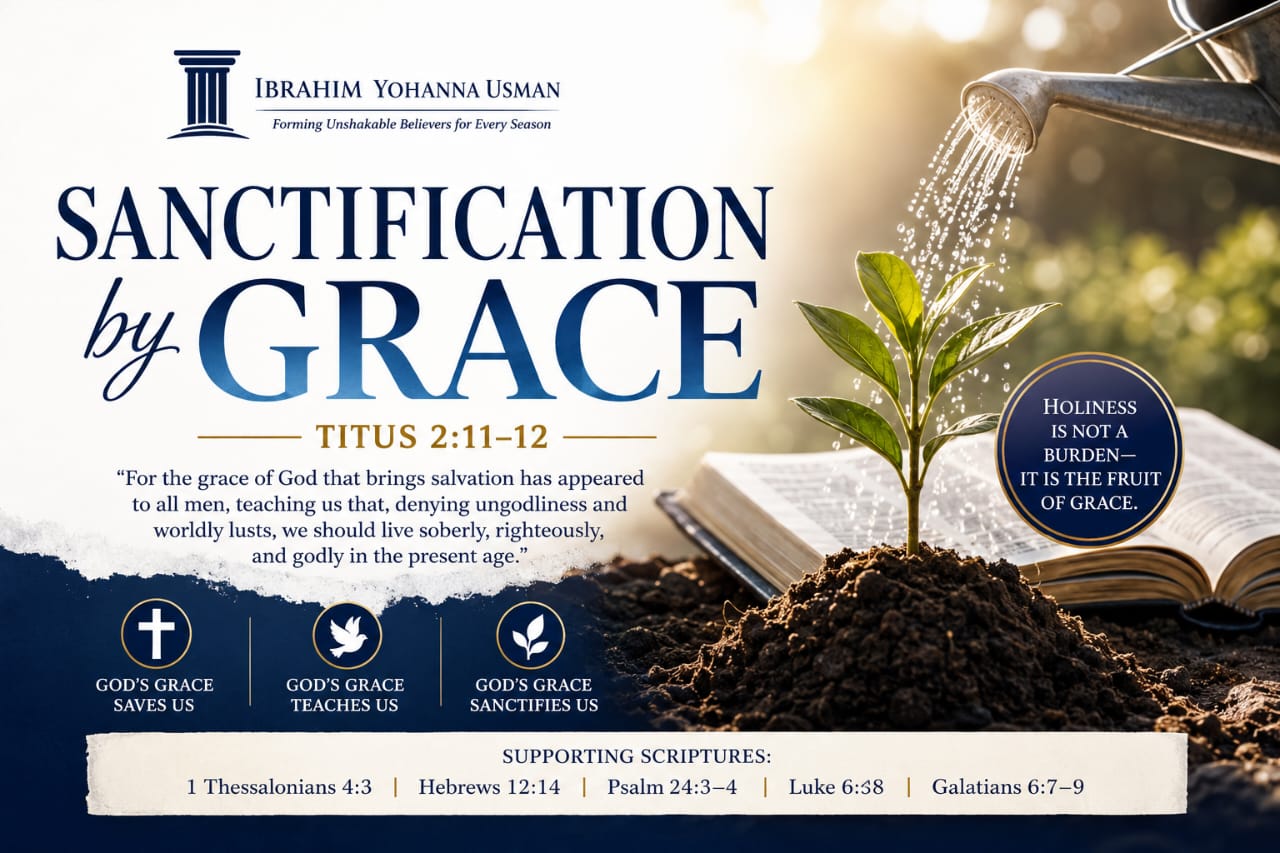
  • Sanctification by Grace

    Sanctification by Grace

    Text: Titus 2:11–12

    Supporting Scriptures: 1 Thessalonians 4:3 • Hebrews 12:14 • Psalm 24:3–4

    Introduction

    One of the greatest misconceptions among Christians is that holiness is achieved by human effort. Many believers struggle to live holy lives because they depend on their own strength instead of God’s grace.The Bible teaches us that holiness is not the price we pay to earn God’s love. Rather, holiness is the evidence that we have already received God’s love and grace.

    God does not make us holy to love us; He makes us holy because He loves us.Grace not only saves us from the penalty of sin; it also delivers us from the power of sin. The same grace that justifies the sinner also sanctifies the believer.

    Titus 2:11–12 tells us that grace is a teacher. It trains us to reject ungodliness and to live lives that please God.

    Scripture Reading

    “For the grace of God that brings salvation has appeared to all men, teaching us that, denying ungodliness and worldly lusts, we should live soberly, righteously, and godly in the present age.”— Titus 2:11–12

    This passage reveals that grace is not permission to continue in sin; grace is God’s power to overcome sin.

    1. Holiness Is God’s Will

    Text: 1 Thessalonians 4:3

    “For this is the will of God, your sanctification…”

    Many believers constantly ask,

    “What is God’s will for my life?”

    Before God reveals His specific will concerning your career, marriage, or ministry, He first reveals His general will—that His children live holy lives.

    Sanctification means being set apart for God.

    • God called Israel to be holy.
    • God called the Church to be holy.
    • God calls every believer today to be holy.

    Holiness is not reserved for pastors, evangelists, or church leaders.It is God’s expectation for every believer.

    What Holiness Is Not

    Holiness is not merely:

    • Wearing certain clothes.
    • Following religious traditions.
    • Avoiding certain foods.
    • Looking spiritually impressive.

    True holiness begins in the heart and transforms every area of life.

    A holy heart produces holy speech, holy thoughts, holy relationships, holy decisions, and holy living.

    2. Grace Empowers Holy Living

    Grace does not lower God’s standard.

    Grace gives us the power to meet God’s standard.

    Many people wrongly believe that grace allows believers to continue living carelessly.

    Paul teaches the opposite.

    • Grace teaches.
    • Grace disciplines.
    • Grace transforms.
    • Grace empowers.

    Without grace, holiness becomes legalism.

    Without holiness, grace becomes cheap.

    The Christian life is not about trying harder.

    It is about surrendering more fully to Christ.

    The Holy Spirit produces holiness as we walk with Him daily.

    Just as fruit grows naturally on a healthy tree, holiness grows naturally in the life of a believer who abides in Christ.

    3. Holiness Enables Intimacy with God

    Text: Hebrews 12:14

    “Pursue peace with all people, and holiness, without which no one will see the Lord.”

    Holiness does not earn God’s presence.

    Holiness prepares us to enjoy God’s presence.

    Psalm 24 asks:

    “Who may ascend into the hill of the Lord?”

    The answer is:

    “He who has clean hands and a pure heart.”

    Sin creates distance.

    Holiness creates fellowship.

    The closer we walk with God, the more His character becomes visible in our lives.

    God desires more than occasional visits.

    He desires daily fellowship.

    4. Sanctification Is a Daily Process

    Salvation happens in a moment.

    Sanctification continues throughout our lives.

    Every day God shapes us into the likeness of Christ.

    Sometimes He uses:

    • His Word
    • Prayer
    • Trials
    • Correction
    • Fellowship with other believers
    • The work of the Holy Spirit

    God is more interested in our character than our comfort.

    Every circumstance becomes an opportunity for Him to make us more like Jesus.

    5. The Evidence of Sanctification

    How do we know we are growing in holiness?

    A sanctified believer demonstrates:

    • Love instead of hatred.
    • Purity instead of compromise.
    • Humility instead of pride.
    • Forgiveness instead of bitterness.
    • Self-control instead of uncontrolled desires.
    • Obedience instead of rebellion.

    The fruit of sanctification is a life that increasingly resembles Christ.

    Practical Application

    How can we cooperate with God’s sanctifying grace?

    1. Desire Holiness
      • Ask God to give you a hunger for righteousness.
    2. Respond to the Holy Spirit’s Correction
      • Do not ignore conviction.Repent quickly whenever God speaks.
    3. Depend Daily on Grace
      • Victory over sin comes through God’s grace, not human strength.
      • Spend time daily in prayer and God’s Word.Walk in obedience to the Holy Spirit.

    Conclusion

    Grace is not an excuse to remain the same.Grace changes us.Grace teaches us.Grace strengthens us.Grace sanctifies us.The God who saved us is also committed to making us holy.

    As we yield ourselves to Him, He transforms us from glory to glory until we become more like Christ.

    May we never resist the work of grace.

    May we pursue holiness with joy.

    May our lives reflect the beauty of Christ to a watching world.

    Closing Prayer

    Heavenly Father,Thank You for the grace that not only saves us but also sanctifies us.

    Purify our hearts.

    Renew our minds.

    Teach us to deny ungodliness and worldly desires.

    Help us to live soberly, righteously, and godly in this present age.

    Fill us daily with Your Holy Spirit and make us more like Jesus.

    Let our lives bring glory to Your holy name.In Jesus’ mighty name we pray. Amen.