
Author: ibrahimyohannausman

  • Grace That Brings Hope and Healing

    Grace That Brings Hope and Healing

    Binding Up the Invisible Wounds

    The “I’m Fine” Mask

    In Nigeria, we have a reflex. No matter how bad things are, when someone asks, “How are you?”, the standard response is a sharp, “I’m fine!” or “We thank God.” We say it while our hearts are breaking. We say it while we are mourning a loss, reeling from a betrayal, or suffocating under debt.

    We have a “Super-hero” complex in our churches. We feel that to admit we are depressed, anxious, or emotionally shattered is to admit that our faith is not working. We treat emotional pain like a “spirit of weakness” to be cast out, rather than a wound to be healed. But God is not just interested in fixing your “circumstances”; He is deeply committed to fixing you.

    The Great Physician’s Specialty

    “He heals the brokenhearted and binds up their wounds.” — Psalm 147:3 (NKJV)

    Notice that the verse doesn’t say He replaces the heart; it says He heals it. This means the pieces of your life that were shattered are not thrown away. Grace is the divine “glue” (the Kintsugi of the Spirit) that puts the pieces back together, making the vessel even stronger and more beautiful than it was before the break.

    From “Forget It” to “Heal It”

    We often think the only way to move past adversity is to “forget the past.” But “forgetting” is not “healing.” Healing is when the memory of the pain no longer has the power to control your present.

    • Grace as the “Balm of Gilead”: In the ancient world, balm was an ointment used to soothe inflammation. Grace acts as an emotional anti-inflammatory. It takes the “sting” out of the disappointment.
    • The Power of Hope: Hope is not a “wish.” In the Greek (elpis), it is a confident expectation of good. Grace provides you with a “Holy Imagination”—the ability to see a future where you are whole again, even while you are currently in pieces.
    • Restoration vs. Replacement: God doesn’t just give you “new things”; He restores the “years that the locusts have eaten.” Grace ensures that your pain does not have the final word in your biography.

    The Sister Who Lost Her Song

    I remember Sister Bunmi, a lead singer in her choir. After a very public and painful broken engagement, she lost her voice—literally and figuratively. She stopped singing. She stopped coming to the front. She felt that her “shame” was written on her forehead.

    She spent two years in a “spiritual cave,” feeling that God was done with her. But slowly, during a season of quiet, personal worship, she felt a “Liquid Hope” wash over her. She didn’t get the man back, but she got her self back. She told her pastor, “Pastor, for the first time, I’m not singing to impress the congregation. I’m singing because I know God loves Bunmi, even the broken version of her.”

    The grace that healed her heart gave her a “new song” that was deeper and more powerful than the old one.

    3 Steps to Emotional Restoration

    1. Stop the “Strong Man” Act: Take off the mask before God. Tell Him exactly where it hurts. You cannot be healed of a wound you refuse to show the Physician. Cry if you need to; Jesus wept, and He had the most faith of anyone.
    2. Apply the “Word-Balm” Daily: Just as you would clean a physical wound every day, you must clean your heart. Find scriptures that speak to God’s love and tenderness (like Psalm 34:18 or Isaiah 61:3) and read them aloud until they sink in.
    3. Give Yourself Time: In Nigeria, we want everything “Sharp-sharp.” But healing is a process, not an event. Don’t let anyone “shame” you into being “over it” before you are ready. Grace provides the patience for the process.

    The Prayer of Activation

    Lord Jesus, I come to You as the Great Physician. You see the wounds that no one else sees—the scars of rejection, the ache of loss, and the heaviness of disappointment. I stop trying to “be strong” in my own power. I ask for Your Balm of Gilead to soothe my soul. I receive Your Hope as an anchor. I declare that my heart is being restored, my joy is returning, and my best days are not behind me. I am healed by Your Grace. Amen.
  • Growing in the Grace of Giving

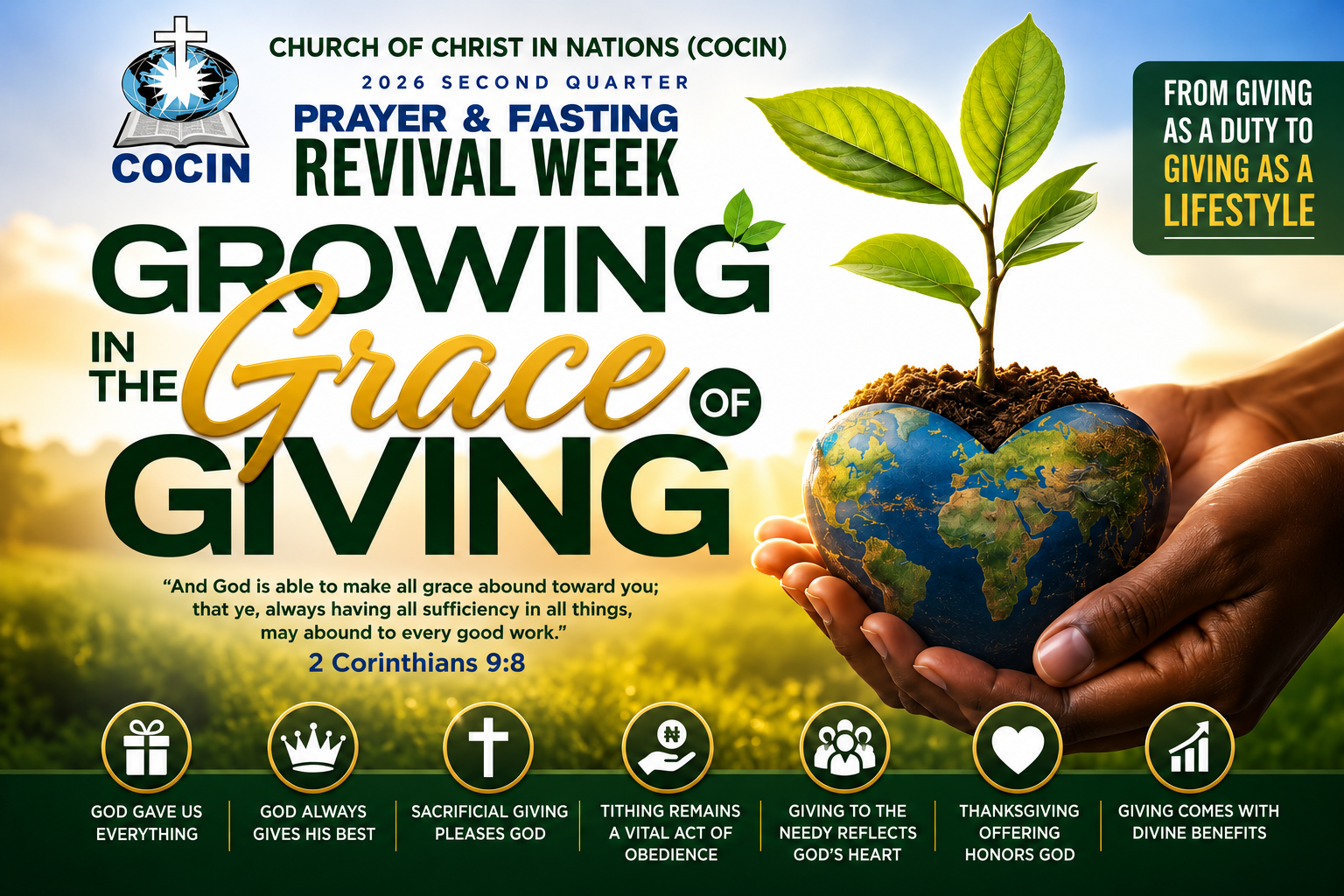
    Growing in the Grace of Giving

    Sermon for the Conclusion of the 2026 Second Quarter Prayer and Fasting Revival Week

    Text: 2 Corinthians 9:6–8

    Supporting Texts: Luke 6:38; Galatians 6:7–9; 1 Corinthians 13:11

    Title:From Giving as a Duty to Giving as a Lifestyle

    Introduction

    Beloved in Christ, we give God all the glory for bringing us to the conclusion of this blessed Revival Week. Throughout this week, God has taken us on a spiritual journey of understanding the grace of giving.

    We have learned that:

    • God gave us everything.
    • God always gives His best.
    • Sacrificial giving pleases God.
    • Tithing remains a vital act of obedience.
    • Giving to the needy reflects God’s heart.
    • Thanksgiving offering honors God.
    • Giving comes with divine benefits.

    Today, we conclude by asking a crucial question:

    Have we merely heard about giving, or have we grown in the grace of giving?

    Paul reminds us in 2 Corinthians 9:8 that God is able to make all grace abound toward us. Giving is not merely a financial activity; it is a grace that must grow within us.

    1. Growth Means Moving from Spiritual Childhood to Spiritual Maturity

    Text: 1 Corinthians 13:11

    “When I was a child, I spoke as a child, I understood as a child… but when I became a man, I put away childish things.”

    One mark of spiritual maturity is generosity.

    • Children always ask, “What can I get?” Mature believers ask, “What can I give?”
    • The immature Christian sees giving as a loss. The mature Christian sees giving as worship.
    • The immature Christian gives only when compelled. The mature Christian gives willingly and cheerfully.

    God is calling COCIN (and all believers) to move from being receivers only to becoming channels of blessing.

    2. Giving Reflects the Character of God

    Text: John 3:16

    “For God so loved the world that He gave…”

    The first thing God did after creating mankind was to give.The greatest thing God ever did for humanity was to give His Son.

    Therefore:

    • Giving is God’s nature.
    • Generosity is God’s language.
    • Sacrifice is God’s pattern.
    • When believers give, they reveal the character of their Heavenly Father.

    The question is not merely whether we give, but whether our giving reflects God’s heart.

    3. Giving Is an Act of Worship

    Text: Exodus 23:25

    Worship the Lord your God, and his blessing will be on your food and water. I will take away disease from among you,

    Our giving is not fundraising alone. Our giving is not a financial transaction. Our giving is worship.

    • Abraham worshipped through sacrifice.
    • David worshipped through costly giving.
    • The widow worshipped through her two mites.
    • The Macedonian believers worshipped through sacrificial generosity.

    Every offering placed before God should say:

    “Lord, I love You. Lord, I trust You. Lord, everything I have belongs to You.”

    4. Giving Activates Kingdom Principles

    Texts: Luke 6:38; Galatians 6:7

    God has established a spiritual law:

    “Give, and it shall be given unto you.”

    The kingdom operates on sowing and reaping.

    • We sow money and reap provision.
    • We sow kindness and reap mercy.
    • We sow service and reap reward.
    • We sow prayers and reap answers.
    • We sow love and reap fellowship.
    • The harvest may not come immediately, but God’s Word never fails.

    Every seed planted in obedience has a harvest attached to it.

    5. The Greatest Gift God Wants Is You

    Before God asks for your money, He asks for your heart.The Macedonians first gave themselves to the Lord (2 Corinthians 8:5).

    Many people give offerings without giving themselves.

    Today God is saying:

    “My son, give me your heart.”

    When God has your heart:

    • Your money follows.
    • Your time follows.
    • Your talents follow.
    • Your service follows.
    • True giving begins with total surrender.

    6. The Benefits of Growing in the Grace of Giving

    God never remains indebted to anyone.

    According to Exodus 23:25–26 and Luke 6:38, the blessings associated with faithful giving include:

    1. Spiritual Benefits
      • Greater intimacy with God
      • Increased faith
      • Joy in serving God
      • Growth in Christlikeness
    2. Physical Benefits
      • Divine provision
      • God’s protection
      • Healing and restoration
      • Fruitfulness and increase
    3. Kingdom Benefits
      • Advancement of the Gospel
      • Care for the needy
      • Growth of the Church
      • Transformation of communities
    4. Eternal Benefits
      • Jesus said: “Lay up for yourselves treasures in heaven.” (Matthew 6:20)

    Every gift given for God’s glory has eternal value.

    Conclusion: Let Us Continue Growing

    As this Revival Week comes to an end, let our growth not end.

    Let us continue:

    • Giving our hearts to God.
    • Giving our tithes faithfully.Giving sacrificially.
    • Giving to the needy.
    • Giving thanksgiving offerings.
    • Giving our talents and time for God’s work.

    May COCIN become known not only as a praying church but also as a generous church.

    • May our homes become generous homes.
    • May our leaders become examples of generosity.
    • May our members abound in every good work.

    Let us leave this Revival Week determined to grow continually in the grace of giving until Christ returns.

    Closing Charge

    “And God is able to make all grace abound toward you; that ye, always having all sufficiency in all things, may abound to every good work.” 2 Corinthians 9:8

    May the Lord enlarge our hearts, increase our faith, multiply our resources, and make us abound in every good work through Christ Jesus. Amen.

  • Grace That Opens New Doors

    Grace That Opens New Doors

    Adversity as a Divine Redirect

    The “Roadblock” on the Expressway

    If you’ve ever traveled from Lagos to Onitsha, you know the frustration of the “Roadblock.” You’re moving at a good pace, your “spirit is high,” and suddenly—there it is. A long line of stationary vehicles, a broken-down tanker, or a security check. Your heart sinks. You think, “This is the end of my journey for today. I will be stuck here until nightfall.”

    But then, you see a local “Okada” or a “Yellow Bus” driver take a sharp, dusty turn into a bush path you never noticed before. You follow them, and twenty minutes later, you’ve bypassed the traffic and discovered a “community route” that is actually shorter and smoother.

    Adversity in our lives often feels like that “No-Entry” sign on the main road. We see the “Closed Door” of a retrenchment letter, a rejected application, or a failed partnership, and we assume God has stopped moving. But Grace is the “Local Guide” that uses the roadblock to push you toward the “Side Gate” you were too busy to see before.

    The Key of David

    “See, I have set before you an open door, and no one can shut it; for you have a little strength, have kept My word, and have not denied My name.” — Revelation 3:8 (NKJV)

    Notice the condition: “You have a little strength.” God doesn’t wait until you are a “Giant” to open the new door. He opens it when you are at your “Little,” provided you have stayed faithful in the “Small” place of your adversity.

    From Dead-End to Detour

    We must shift our mindset from seeing adversity as a Wall to seeing it as a Gateway.

    • Grace as a Locksmith: Sometimes God allows a door to be slammed in your face because He knows that if you stayed in that “comfortable” room, you would never fulfill your global destiny.
    • The “Back-Door” Blessing: In the Kingdom, your greatest testimony is often born from the “failure” of your original plan.
    • Divine Rejection is Divine Protection: Grace often blocks the “Good” door so you can find the “God” door.

    The “Visa Denied” Testimony

    I think of a young man named Bode. He was a brilliant IT student who wanted nothing more than to leave Nigeria for a master’s program in the UK. He spent every kobo he had on the application. He was a faithful tither. He fasted. Yet, his visa was denied—not once, but twice.

    Bode was devastated. He felt God had mocked him. “In his anger,” he stayed back and used the little money he had left to start a small coding hub in an old garage in Yaba. Because he was “stuck” in Nigeria, he focused all his energy on solving local problems. Three years later, his startup was acquired by a Silicon Valley giant for millions of dollars.

    If Bode had gone to the UK, he would have been another “average” student. Because Grace “closed” the UK door, it forced him into the “Tech Mogul” door. His adversity was his gateway.

    3 Steps to Find Your “Side Gate”

    1. Stop Banging on the Closed Door: If a door has been shut and locked for a long time, stop wasting your “Little Strength” trying to break it down. Turn around and ask: “Lord, where is the window You’ve opened?”
    2. Audit Your “Small Strength”: What do you have in your hand right now? Elisha’s widow thought she had nothing, but she had a “little oil.” Grace doesn’t need a forest to start a fire; it only needs a spark.
    3. Stay Sensitive to the “Small” Opportunities: New doors rarely look like “Palace Gates” at first. They often look like a small suggestion from a friend, a “casual” conversation, or a problem in your neighborhood that needs solving.

    The Prayer of Activation

    Lord, I thank You that You are the one who opens doors that no man can shut. I repent for the time I spent crying over the “No Entry” signs in my life. I receive the Grace of the “Local Guide” to show me the hidden paths You have prepared for me. I declare that my current disappointment is actually a divine appointment. Open my eyes to see the “back-door” blessings You have placed in this season. Amen.

  • Grace That Produces Spiritual Growth

    Grace That Produces Spiritual Growth

    Maturity in the Midst of the Mess

    The “Pounded Yam” Philosophy

    Have you ever watched the process of making authentic pounded yam? It is a violent affair. The yam is boiled until it’s soft, then it is thrown into a mortar and beaten repeatedly with a heavy pestle. To a stranger, it looks like an assault. But to the Nigerian, we know the “beating” is what creates the texture. Without the pestle, it’s just boiled yam; with the pestle, it becomes a masterpiece fit for a king.

    Many of us want to be “Mighty Men and Women of God,” but we don’t want the “pestle” of adversity. We want the “Anointing” without the “Agony.” We want to be “Solid Believers,” but we cry the moment life gives us a little “shaking.”

    Grace isn’t just a soft pillow to cry on; it is the Growth Hormone of the spirit. It is the power that ensures that when you come out of the fire, you don’t just smell like smoke—you look like gold.

    The Perfection of Patience

    “My brethren, count it all joy when you fall into various trials, knowing that the testing of your faith produces patience. But let patience have its perfect work, that you may be perfect and complete, lacking nothing.” — James 1:2–4 (NKJV)

    James isn’t saying we should be happy about the pain, but we should be joyful because of what the pain is producing. The word “perfect” here doesn’t mean sinless; it means “Mature”—like a fruit that is finally ripe and ready for the market.

    From Comfort to Character

    We often pray for “Comfort,” but Grace is more interested in your “Character.” In the Kingdom of God, a “Blessing” given to an immature person is actually a “Burden.”

    • Grace as a Teacher: Titus 2:11–12 says Grace “teaches” us. Adversity is God’s classroom. You learn things about God’s faithfulness in a “low” season that you could never learn at a “High Praise” concert.
    • The Removal of “Dross”: In the fire of adversity, the things that don’t matter (pride, self-reliance, “show-off” faith) are melted away. What remains is the “Real You.”
    • Expansion of Capacity: You cannot carry a heavy “Level 5” blessing with “Level 1” spiritual muscles. Grace uses your trials as a “Gym” to build the muscles you’ll need for your next level.

    The “Iron Lady” of the Market

    I heard of a woman named Mama Blessing. For years, she was a “fair-weather” Christian. If her business was good, she was in church; if she had a small headache, she was nowhere to be found. Then, her husband passed away, and she was left to cater for five children alone.

    For three years, she struggled. She faced insults from in-laws and the “wahala” of the market environment. But something happened. The woman who used to cry over every small thing became a “Lioness.” She became a woman of deep prayer. Her “Baby Faith” died, and a “General’s Faith” was born.

    When met by her pastor, she said, “Pastor, the Mama Blessing you knew five years ago is dead. That woman couldn’t handle what I am handling now. I thank God for the ‘hard road’ because it made me see the ‘Great God.’”

    3 Practical Steps to Grow Through the Pain

    1. Stop Asking “When Will This End?” and Start Asking “What Must I Learn?”: If you only focus on the exit, you miss the lesson. Ask God: “What part of my character are You working on right now?”
    2. Submit to the “Pestle”: Don’t be “hard-hearted.” If God is using a situation to teach you humility or patience, don’t fight it. The more you resist the “pounding,” the longer the process takes.
    3. Feed Your Spirit, Not Your Self-Pity: When you are in a trial, you have a choice: you can feed your “Inner Victim” or your “Inner Victor.” Listen to messages, read the Word, and stay around “Iron-sharpening-iron” friends.

    The Prayer of Activation

    Father, I thank You that You love me too much to leave me as a “Baby Christian.” I thank You for the “beating” that is producing “Pounded Yam” texture in my life. I stop complaining about the heat and start cooperating with the Refiner. Give me the grace to learn the lessons of this season quickly. I declare that I will come out of this trial more mature, more complete, and lacking nothing. Amen.

  • Grace That Preserves Faith

    Grace That Preserves Faith

    Standing Firm When the Ground Shakes

    Introduction

    The Temptation of the “Alternative”

    In Nigeria, we are familiar with the “shaking ground.” It could be the sudden announcement of a new government policy that triples your cost of living overnight, or a “disastrous” health report that comes out of nowhere. When these things happen, your faith is not just tested; it is sifted.

    There is a specific pressure that comes with Nigerian adversity—the temptation to look for an “Alternative.” When the “Amen” doesn’t seem to be working, the whispers start. A well-meaning relative suggests a “special prophet” in a distant village who sees “deep things.” A colleague mentions a “shortcut” at work that involves a little dishonesty but promises a big “breakthrough.”

    The greatest danger in adversity isn’t the loss of your money or your health; it’s the loss of your anchor. You find yourself asking, “Is God even there? Does this ‘Christian thing’ actually work?” If you’ve ever felt like walking away from it all because the “wahala” is too much, this chapter is for you.

    The Prayer for Your “Sifting”

    “Simon, Simon! Indeed, Satan has asked for you, that he may sift you as wheat. But I have prayed for you, that your faith should not fail; and when you have returned to Me, strengthen your brethren.” — Luke 22:31–32 (NKJV)

    Notice that Jesus didn’t pray that Peter would avoid the sifting. He didn’t stop the trial from happening. He prayed for the core: the faith.

    In our context, sifting is like when you use a sieve to separate the stones from the garri. The shaking is violent, and it feels like you are being destroyed. But Grace is the invisible hand that ensures the “pure grain” of your trust in God doesn’t fall through the mesh.

    From My Grip to His Grip

    We often think faith is something we do for God. We think, “I must hold onto God tightly!” But when you are exhausted, your grip slips.

    The “Grace Shift” happens when you realize that Faith is not you holding onto God; it is Grace holding your hand onto His.

    • Preserving Grace is “The Anchor”: Like a ship in a storm at Bar Beach, you don’t stay in place because the water is calm. You stay in place because the anchor is deep.
    • It Guards the Heart from Bitterness: The greatest “Preservation” is not just staying in church, but staying in love with God. Grace prevents the “poison” of your circumstances from reaching your spirit.
    • It Provides “Night Vision”: Preservation doesn’t mean you see the whole road; it means you have just enough light for the next step so you don’t stumble into the ditch of apostasy.

    The Sister in the “Silent” Marriage

    I remember Sister Titi. She was married to a man who, after five years, suddenly abandoned his faith and became abusive and distant. Titi was a “pillar” in her local assembly. She fasted, she “sowed,” she did “warfare,” but the situation only got worse.

    She told her pastor, “Pastor, there was a night I held a bottle of pills. I was done. I told God, ‘You failed me, so I’m leaving.’” But in that moment, she said she felt a “sudden heaviness”—not of sorrow, but of peace. It was as if someone physically held her hand down. She didn’t get a “breakthrough” that night, but she got the “Preservation” to survive the night. Today, Titi is not just a survivor; she is a counselor for women in crisis. The grace didn’t save her marriage (yet), but it saved her.

    3 Steps to Keep Your Faith from Failing

    1. Stop “Performance” Faith: If you are too tired to “pray in tongues” for three hours, don’t feel guilty. Grace is for the weak. Sometimes, the most faithful prayer is simply: “Lord, help me stay.”
    2. Avoid “Faith-Killers”: In Nigeria, bad news travels fast on WhatsApp. If your faith is shaking, turn off the “doomscrolling.” Surround yourself with the Word and with people who speak life, not “village people” theories.
    3. Remember Your “Last Testimony”: When the present is dark, look at the “Ebenezer” stones in your past. Remind yourself: “The God who provided for me during the 2016 recession is the same God today.” Grace is consistent.

    The Prayer of Activation

    Lord Jesus, I thank You that You are praying for me right now, just as You prayed for Peter. I admit that my heart is shaking and my grip is weak. I stop trying to hold onto You by my own power. I ask for Your Preserving Grace to hold me. Guard my heart from bitterness. Keep me from looking for “alternatives” that lead to death. I declare that even in this sifting, I will not fail. I am anchored in You. Amen

  • Paul — Grace in Weakness

    Paul — Grace in Weakness

    When the Thorn Remains

    Introduction

    The Testimony We Don’t Share

    Go to any “Testimony Time” in a vibrant Nigerian church, and the script is usually the same: “I had a problem, I prayed, and God took it away! Praise the Lord!” We love the stories of the cancer disappearing, the debt being wiped clean, or the “wicked” motherin-law suddenly having a change of heart.

    But what about the believer who has prayed “Mountain-Moving” prayers for seven years, yet the “mountain” hasn’t moved an inch? What about the sister who is a prayer warrior but still manages a chronic health condition every single day? In our context, we often feel ashamed of these “thorns.” We think it means our faith is “weak” or we have a “secret sin.” Paul’s life shatters that lie. He shows us that sometimes, God leaves the thorn because He wants to display a power that is greater than a simple healing.

    The Sufficiency Clause

    “And He said to me, ‘My grace is sufficient for you, for My strength is made perfect in weakness.’ Therefore most gladly I will rather boast in my infirmities, that the power of Christ may rest upon me.” — 2 Corinthians 12:9 (NKJV)

    Paul was the man who raised the dead and shook off vipers, yet he had a “thorn in the flesh” that he begged God to remove three times. We don’t know exactly what it was—perhaps a physical ailment or a persistent critic—but we know it was painful. God’sanswer wasn’t a “Breakthrough” in the way we usually define it. His answer was a Guarantee of Capacity.

    From Eraser to Battery

    Most of us treat Grace like an Eraser—we want it to rub out the difficult parts of our lives. But Paul learned to treat Grace like a Battery.

    • The Paradox: Grace doesn’t wait for you to be “strong” to show up. It waits for you to be “weak.” In the Kingdom of God, your “Zero” is the starting point for His “Infinity.”
    • The Sustenance: If God removes the challenge, you see His Hand. If God sustains you through the challenge, the world sees His Character.
    • The Boast: Paul didn’t just “endure” his weakness; he “boasted” in it. He realized his weakness was the “WiFi signal” that kept him connected to God’s power.

    The Minister in the Wheelchair

    I remember a brother named Samuel (not his real name). He was a brilliant evangelist in Logos (not his actual location), known for his energy. Then, a tragic auto crash left him paralyzed from the waist down. Many in his circle expected him to stop “preaching” and start “seeking deliverance.” They felt a man in a wheelchair couldn’t talk about a “Powerful God.”

    Samuel didn’t stop. He continued his ministry, often being carried onto the pulpit. He said, “When I stood on my two legs, people saw Samuel. Now that I am in this chair, when I speak and souls are saved, they know it isn’t Samuel—it is only the Grace of God.” His “thorn” didn’t stop the message; it actually made the message louder. The grace that kept him joyful in that chair was a bigger miracle than the crash itself.

    3 Steps to Live with a “Thorn”

    • 1. Stop the “Deliverance-Only” Obsession: It is okay to pray for removal. But after you have prayed, ask for Sustenance. If the thorn is still there today, it means there is a “Special Grace” available for you today.
    • 2. Audit Your “Boast”: Stop hiding your struggles to look “super-spiritual” to your church members. When you are honest about your weakness, you give God a chance to be the Hero of your story.
    • 3. Lean into the “Perfected” Strength: When you feel “I can’t do this anymore” (whether it’s a difficult marriage, a health issue, or a financial struggle), say out loud: “Lord, my strength is at zero. This is the perfect time for Your power to show up.”

    The Prayer of Activation

    Father, I thank You that Your Grace is not just for the “finish line,” but for every step of the race. I stop fighting my “thorn” with my own strength. I admit that I am weak, I am tired, and I am at my limit. I receive Your Sufficient Grace right now. Let Your power rest upon my infirmity. If the mountain doesn’t move today, give me the grace to climb it with a song in my heart. Amen.

  • Is Church Wedding and Marriage Sanctification Biblical or Traditional?

    Is Church Wedding and Marriage Sanctification Biblical or Traditional?

    Understanding the Biblical Foundation of Christian Marriage

    Texts: Genesis 2:18–24; Hebrews 13:4; John 2:1–11; 1 Timothy 4:4–5; Malachi 2:14

    Objective:

    To help believers understand the difference between God’s commands and Christian traditions in marriage—so they can honor God wisely and live according to biblical truth.


    Introduction

    Marriage is one of the oldest and most sacred institutions established by God Himself. Over time, however, cultures and churches have added various traditions and practices. This has raised important questions among believers:

    • Is a church wedding biblical or just a human tradition?
    • Is marriage sanctification biblical or traditional?
    • Is it sinful not to sanctify a marriage?

    Let us examine these questions carefully, using the Word of God as our final authority.


    Part 1: Is Church Wedding Biblical or Traditional?

    1. Marriage Itself Is Biblical

    From the beginning, marriage was instituted by God:

    • Genesis 2:18–24 – God established marriage at creation.
    • Hebrews 13:4 – “Marriage is honorable in all.”

    Marriage is not a human invention—it is God’s design, and it is holy and honorable before Him.


    2. The Church Wedding Is a Tradition

    The Bible does not command that weddings must take place in a church building or be officiated by a pastor.

    • In biblical times, weddings were family and community events, often held in homes.
    • John 2:1–11 – The wedding at Cana took place in a home, not a temple.

    3. Why Church Weddings Developed

    Church weddings emerged for meaningful and practical reasons:

    • To make marriage public before the Christian community
    • To provide spiritual guidance and pastoral blessing
    • To prevent secret or ungodly unions
    • To begin marriage in God’s presence and under His Word

    4. Biblical Principles Behind Church Weddings

    Although the format is traditional, it reflects strong biblical values:

    • Public covenant – Ruth 4:9–11; Malachi 2:14
    • Acknowledging God – Proverbs 3:6
    • Community witness – Matthew 18:19–20
    • Christ’s presence – John 2:1–11

    Conclusion (Part 1)

    A church wedding is not commanded in Scripture, but it is biblically inspired. It is a good and godly tradition—not necessary for salvation, but wise for accountability and blessing.


    Part 2: Is Marriage Sanctification Biblical or Traditional?

    1. What Is Marriage Sanctification?

    To sanctify means to set apart, dedicate, or make holy. In the church context, it involves:

    • Praying for God’s blessing
    • Committing the couple to live according to God’s Word

    2. Biblical Foundation

    The concept of sanctifying marriage is rooted in Scripture:

    • Genesis 2:24 – Marriage established by God
    • Hebrews 13:4 – Marriage should be honored and kept pure
    • John 2:1–11 – Jesus honored a wedding with His presence
    • 1 Timothy 4:4–5 – Sanctified by the Word of God and prayer

    3. The Traditional Expression

    The formal ceremony—where pastors pray, anoint, and bless the couple—is a Christian tradition built on biblical truth.

    It reflects the broader command:

    • Proverbs 3:6 – “In all your ways acknowledge Him.”

    Conclusion (Part 2)

    The principle of marriage sanctification is biblical, while the ceremony itself is traditional. Nevertheless, it is a meaningful and spiritually rich practice rooted in Scripture.


    Part 3: Is It Sinful Not to Sanctify a Marriage?

    1. Marriage Is Honorable Without a Church Ceremony

    • Hebrews 13:4 – “Marriage is honorable in all…”

    A marriage can still be valid and honorable before God without a formal church ceremony—provided it is:

    • Lawful
    • Faithful
    • Not immoral or secret

    2. Excluding God Is Spiritually Unwise

    • Psalm 127:1 – “Except the Lord build the house…”
    • Proverbs 3:6 – Acknowledge God in all your ways

    Even if not sinful, neglecting God’s involvement weakens the spiritual foundation of marriage.


    3. When It Becomes Sinful

    It becomes sinful when:

    • God’s authority is rejected
    • His Word is ignored
    • Godly counsel is resisted
    • The relationship is immoral (fornication or adultery)

    Conclusion (Part 3)

    Not having a sanctification ceremony is not a sin, but excluding God is unwise. The issue is not the form—but the heart and obedience to God.


    Summary

    • Church Wedding: Marriage is biblical; the ceremony is a Christian tradition—helpful but not mandatory.
    • Marriage Sanctification: Biblical in principle; traditional in expression.
    • Not Sanctifying a Marriage: Not sinful if honorable—but unwise if God is ignored.

    Key Takeaways

    1. Marriage is God’s holy institution—honor it and keep it pure.
    2. Traditions are valuable when they reflect biblical truth.
    3. Seek God’s presence in all things—not as ritual, but as relationship.
    4. Honor marriage publicly, faithfully, and spiritually.
    5. Invite Jesus into your marriage from the beginning (John 2:1–11).

    Closing Exhortation

    Whether in a church, home, or courtyard, the most important thing is that God is present in your marriage.

    A couple that builds on the Word of God and prayer will stand strong through every season of life.

    Psalm 127:1
    “Except the Lord build the house, they labour in vain that build it.”

  • Esther — Grace for Such a Time as This

    Esther — Grace for Such a Time as This

    Divine Positioning in the Face of Peril

    The “Connection” and the “Cost”

    In Nigeria, we talk a lot about “favor.” We pray for “divine connections” and “open doors” into the corridors of power. We celebrate when a “son of the soil” is appointed as a Minister or when a sister from our local assembly is promoted to the executive board of a multinational bank. We call it a “testimony.”

    But what happens when that testimony turns into a trial? What do you do when your “open door” leads you into a room where you are the only one who can stop a “Haman” from destroying your people?

    Maybe you’re the accountant who discovers a massive fraud that will bankrupt the company, but the people involved are your “Godfathers.” Maybe you are the community leader asked to sign away ancestral lands for a pittance. Suddenly, the palace doesn’t feel like a blessing; it feels like a trap. You’re asking, “God, why did You bring me here if I have to risk everything to do the right thing?”

    The “If I Perish” Resolve”

    For if you remain completely silent at this time, relief and deliverance will arise for the Jews from another place, but you and your father’s house will perish. Yet who knows whether you have come to the kingdom for such a time as this?” — Esther 4:14 (NKJV)

    Esther was a “displaced person”—an orphan and a minority in a foreign land. By God’s grace, she was selected as Queen. But when a decree was signed to wipe out her people, her crown became a heavy weight. Mordecai’s words remind us that Grace is not just for our promotion; it is for our participation in God’s plan.

    From Favor to Fortitude

    We often view Esther’s story as a “Beauty Queen” story. But the “Grace Shift” happens when we realize that Grace is the fuel for Courage.

    • Grace for Strategy: Esther didn’t just barge into the King’s presence shouting. Grace gave her the wisdom to host two banquets and wait for the right moment.
    • Grace for Sacrifice: True grace gives you the “Holy Boldness” to say, “If I perish, I perish.” It is the supernatural ability to value God’s purpose more than your own “security.”
    • Grace for Positioning: You are not where you are by mistake. Even in a “corrupt” system, God places “Esthers” as secret agents of His mercy.

    The Auditor’s Choice

    I remember Sister Ngozi, a quiet but brilliant auditor in a Federal Ministry. She discovered that a “Big Oga” was diverting funds meant for a rural hospital project. She knew that if she reported it, her career would be over—or worse. Her family told her to “mind her business” and “not play hero in Nigeria.”

    But during a three-day fast, she felt the “Esther Grace.” She didn’t act out of anger; she acted out of an “assignment.” She strategically leaked the documents to the right oversight committee while remaining anonymous for as long as possible. The “Haman” in her office was eventually reassigned, and the funds were released. She didn’t get a medal, but she kept her soul. The grace that gave her the “wisdom of the serpent and the harmlessness of the dove” was her greatest asset.

    3 Steps to Exercise “Esther Grace”

    • 1. Acknowledge Your Assignment: Ask yourself: “Why has God placed me in this specific office, family, or neighborhood at this specific time?” Look past the salary and see the souls.
    • 2. Fast for Favor: Before Esther spoke to the King, she spoke to the King of Kings. When the stakes are high, don’t just “move”—pray and fast. Spiritual preparation precedes physical manifestation.
    • 3. Use Your Influence Wisely: Influence is a “loan” from God. Use it to speak for those who have no voice. Whether it’s helping a junior staff member who is being bullied or standing for truth in a meeting, use your “Palace” position for “Pit” people.

    The Prayer of Activation

    Lord God, I thank You for the platform You have given me. I recognize that I am not here by chance, but for “such a time as this.” I receive the courage to stand for truth even when it is uncomfortable. I receive the wisdom to navigate difficult systems without compromising my faith. I declare that I will not be silent when I should speak. Let Your grace make me a vessel of deliverance for my generation. Amen.

  • David — Grace in Opposition and Failure

    David — Grace in Opposition and Failure

    The Fugitive and the Fallen

    INTRODUCTION

    In Nigeria, we often celebrate David the giant-killer, but we forget David the cave-dweller and David the broken-hearted sinner. This chapter is about the grace that protects us from others and the grace that protects us from ourselves.

    The “Oga” Who Wants You Down

    In our workspace and even in our families, there is a phenomenon we often encounter: the “Saul Spirit.” You are talented, you are anointed, and you have been “counting your stars,” but suddenly, your boss—the “Oga at the top”—begins to see you as a threat. You haven’t done anything wrong; in fact, you’ve been “playing the harp” to soothe their spirit, yet they are throwing spears at you.

    Then there is the other side of the Nigerian struggle: The Weight of Shame. In a culture that values “face” and reputation, making a big mistake—a moral failure, a financial scandal, or a massive business blunder—feels like a death sentence. You feel that because you’ve “spoilt everything,” God’s grace has been withdrawn like a revoked license. David’s life shows us that grace is big enough for both the spear-dodger and the sinner.

    The Cave and the Confession

    “Be merciful to me, O God, be merciful to me! For my soul trusts in You; And in the shadow of Your wings I will make my refuge, until these calamities have passed by.” — Psalm 57:1 (NKJV)

    David wrote this while hiding in a cave from Saul. Later, after his failure with Bathsheba, he wrote:

    “The sacrifices of God are a broken spirit, a broken and a contrite heart—these, O God, You will not despise.” —Psalm 51:17 (NKJV)

    From Defense to Dependence

    We usually try to fight our “Sauls” with our own spears, or we try to hide our “Bathshebas” with our own lies. Grace invites us to a different way.

    • Grace in Opposition: David had the chance to “finish” Saul in the cave. But Grace taught him that he didn’t need to touch the “Lord’s anointed” to get to the throne. Grace is the confidence that God is your PR Manager. You don’t need to fight every battle; some battles are won by simply staying in the cave until the storm passes.
    • Grace in Failure: Many of us think God’s grace is for “small” sins. David’s sin was heavy—adultery and murder. Yet, when he stopped making excuses and started making a confession, Grace met him. The shift is this: Your mistake did not catch God by surprise. His grace was already at the finish line of your failure, waiting to pick you up.

    The Sacked Manager

    I remember a brother named Emeka who was a rising star in a top bank. His supervisor, jealous of his connection with the MD, framed him for a procedural error. Emeka was sacked. He went from a “Prado” to a “Yellow Bus” overnight. For three years, he was in the “Cave of Adullam,” struggling to feed his family.

    During that time, Emeka fell into a deep depression and made some poor choices that almost cost him his marriage. He felt he had failed God. But one morning, during a low-key prayer meeting, he felt a “Heavy Mercy” wash over him. He repented, reconciled with his wife, and started a small consulting firm. Five years later, the truth about the bank frame-up came out. The bank didn’t just apologize; they hired his new firm as their primary consultants.

    The “Saul” (his supervisor) was gone, and the “Bathsheba” (his season of failure) was redeemed. Grace was the bridge that brought him back.

    3 Practical Steps for the “Cave” and the “Fall”

    1. Drop the Spear: If you are being persecuted at work or in the family, don’t use “carnal” weapons. Don’t gossip back. Don’t “do” juju. Don’t bribe. Let Grace be your defense. When you defend yourself, God steps back; when you let Him defend you, He steps forward.

    2. Come Clean Quickly: If you have messed up, stop “masking” it. In Nigeria, we say “Image is everything,” but in the Kingdom, Integrity is everything. Grace flows to the humble, but it is blocked by the proud.

    3. Remember the “Anointing” Still Counts: David was still the “Anointed King” even while he was running for his life in the bush. Your current “low” state doesn’t cancel your “high” calling

    The Prayer of Activation

    Lord, I thank You that You are the Shield for my head when spears are flying. I refuse to take revenge on my “Sauls.” I trust Your timing for my promotion. And Father, where I have fallen, I do not run away from You; I run to You. I thank You that Your mercy is new every morning and that my past is not my prison. I receive the grace to stand up, wash my face, and walk into my palace. Amen.

  • Job — Grace in Loss and Confusion

    Job — Grace in Loss and Confusion

    Faith Without Explanations

    Introduction

    In this chapter, we deal with the hardest kind of adversity: the kind that makes no sense. If Joseph’s story was about the “Enemy Without” (betrayal), Job’s story is about the “Silence Above.”

    When the “Hedge” Breaks

    In our Nigerian Christian experience, we love the “Hedge of Protection.” We pray for it every morning. We believe that if we are faithful in our tithes, our “first fruits,” and our service, God is duty-bound to keep the “devourer” away from our goats, our cars, and our children. We view God’s favor as a spiritual fence.

    But what happens when the fence is breached?

    What do you do when you are the “best” Christian in your local government—honest in business, faithful in marriage, fervent in prayer—and yet, in one “black week,” everything collapses? The business you spent twenty years building goes under because of a sudden policy change. The child you raised in the way of the Lord falls ill. The “Why?” that screams in your soul is louder than any worship song. In our context, people will start asking, “Job, what is in your cupboard? Confess!” But Job’s story teaches us that sometimes, the greatest trials happen to the greatest saints.

    The Naked Truth

    “Naked I came from my mother’s womb, and naked shall I return there. The Lord gave, and the Lord has taken away; Blessed be the name of the Lord.” — Job 1:21 (NKJV)

    Job’s grace was not found in his bank account or his health; it was found in his theology of ownership. He understood something we often forget in our “blessing-obsessed” culture: Everything we have is on loan. Grace gave Job the ability to worship God for who He is, not just for what He provides.

    From Restoration to Revelation

    We often rush to the end of Job’s story to talk about the “Double Portion”—the new cows and the new children. But that is not the point of the book. The real Grace was what happened in the middle of the ash heap.

    • Grace in the Silence: When God didn’t answer Job’s “Why?”, He was giving Job His “Who.”
    • The Shift: Grace shifted Job from knowing about God to seeing God. He said, “I had heard of you by the hearing of the ear, but now my eye sees you” (Job 42:5).
    • The Lesson: Sometimes God allows the “Hand” of His provision to be withdrawn so that you can finally see the “Face” of the Provider.

    The “Big Man” Who Lost It All

    I think of Chief Ade, a man known in his community for his philanthropy and his deep faith. In the 2023 economic downturn, his manufacturing firm collapsed. He lost his houses, his luxury cars, and—most painfully—the “respect” of his peers who used to flock to his parlor.

    For a year, Chief Ade took the “bus” like everyone else. His “friends” disappeared, claiming he must have “lost his mantle.” But during that year, the Chief started a small Bible study in his humble rented apartment. He told his pastor later: “When I had the millions, I prayed to God. But now that I have nothing, I talk to Him. I realized I was in love with His gifts, but now I am in love with Him.” The grace that sustained Chief Ade in the “bus” was more powerful than the grace that bought him the Mercedes.

    3 Steps to Handle “Silent” Adversity

    1. Give Yourself Permission to Lament: Grace doesn’t mean you must “fake” a smile. Job cried, he scraped his sores, and he questioned God. God can handle your honesty. Don’t let “religious” people tell you that mourning is a lack of faith.
    2. Separate the Giver from the Gift: Take a moment to ask: “If everything I worked for was gone tomorrow, would I still trust God’s character?” If the answer is “I don’t know,” ask for the grace to see His face, not just His hand.
    3. Silence the “Comforters”: Job’s friends were his biggest trial. They tried to find “sin” where there was only “testing.” When you are in a Job season, be careful who you listen to. Not every “Christian” advice is word of “God”.

    The Prayer of Activation

    Lord, I admit that I am confused. I don’t understand why this hedge has broken or why the “Why?” remains unanswered. But like Job, I declare that my Redeemer lives. I refuse to curse You or walk away because of my losses. Give me the grace to see You in the middle of this ash heap. I shift my gaze from what I have lost to who You are. You are enough for me, even in the silence. Amen.