
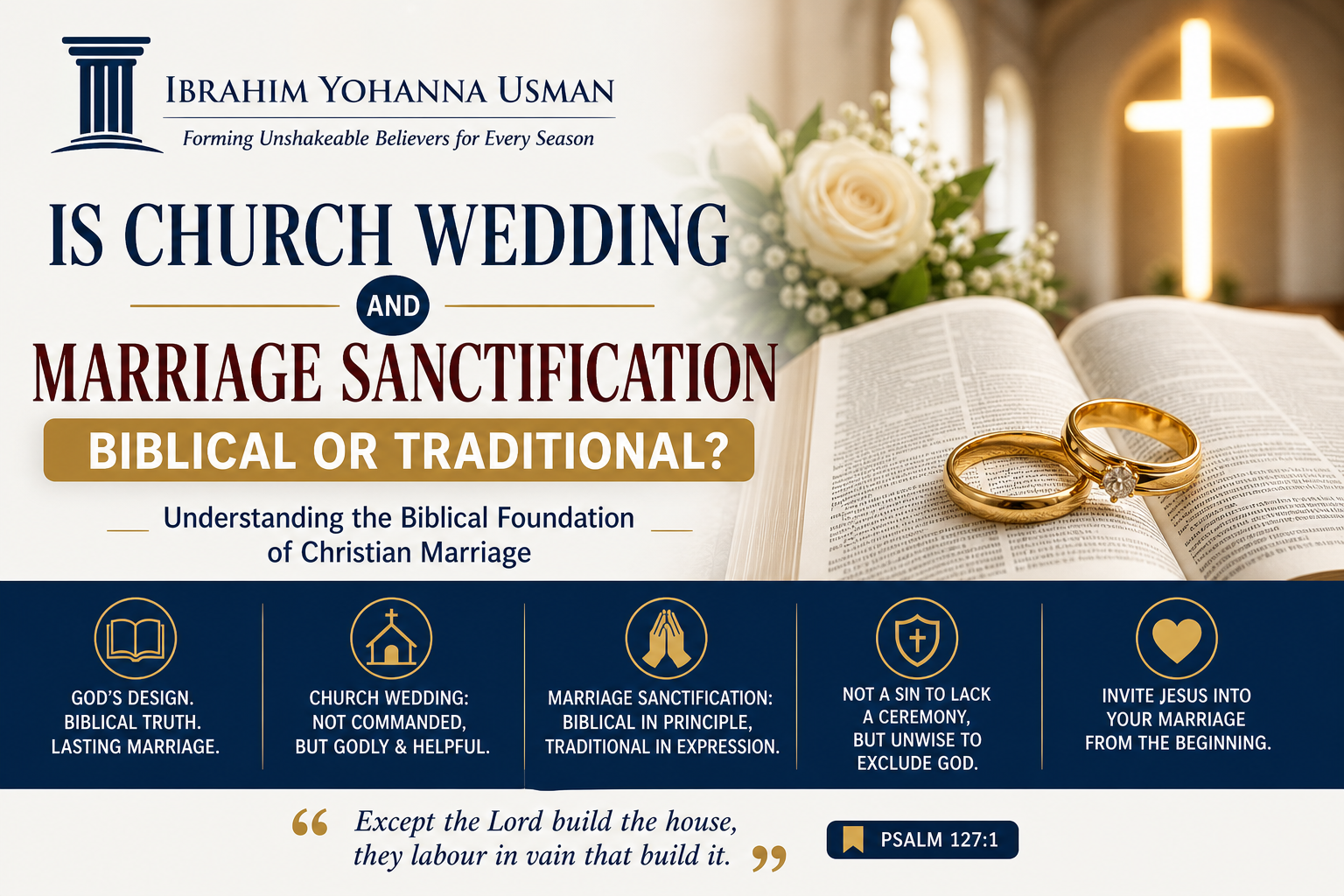
Understanding the Biblical Foundation of Christian Marriage
Texts: Genesis 2:18–24; Hebrews 13:4; John 2:1–11; 1 Timothy 4:4–5; Malachi 2:14
Objective:
To help believers understand the difference between God’s commands and Christian traditions in marriage—so they can honor God wisely and live according to biblical truth.
Introduction
Marriage is one of the oldest and most sacred institutions established by God Himself. Over time, however, cultures and churches have added various traditions and practices. This has raised important questions among believers:
- Is a church wedding biblical or just a human tradition?
- Is marriage sanctification biblical or traditional?
- Is it sinful not to sanctify a marriage?
Let us examine these questions carefully, using the Word of God as our final authority.
Part 1: Is Church Wedding Biblical or Traditional?
1. Marriage Itself Is Biblical
From the beginning, marriage was instituted by God:
- Genesis 2:18–24 – God established marriage at creation.
- Hebrews 13:4 – “Marriage is honorable in all.”
Marriage is not a human invention—it is God’s design, and it is holy and honorable before Him.
2. The Church Wedding Is a Tradition
The Bible does not command that weddings must take place in a church building or be officiated by a pastor.
- In biblical times, weddings were family and community events, often held in homes.
- John 2:1–11 – The wedding at Cana took place in a home, not a temple.
3. Why Church Weddings Developed
Church weddings emerged for meaningful and practical reasons:
- To make marriage public before the Christian community
- To provide spiritual guidance and pastoral blessing
- To prevent secret or ungodly unions
- To begin marriage in God’s presence and under His Word
4. Biblical Principles Behind Church Weddings
Although the format is traditional, it reflects strong biblical values:
- Public covenant – Ruth 4:9–11; Malachi 2:14
- Acknowledging God – Proverbs 3:6
- Community witness – Matthew 18:19–20
- Christ’s presence – John 2:1–11
Conclusion (Part 1)
A church wedding is not commanded in Scripture, but it is biblically inspired. It is a good and godly tradition—not necessary for salvation, but wise for accountability and blessing.
Part 2: Is Marriage Sanctification Biblical or Traditional?
1. What Is Marriage Sanctification?
To sanctify means to set apart, dedicate, or make holy. In the church context, it involves:
- Praying for God’s blessing
- Committing the couple to live according to God’s Word
2. Biblical Foundation
The concept of sanctifying marriage is rooted in Scripture:
- Genesis 2:24 – Marriage established by God
- Hebrews 13:4 – Marriage should be honored and kept pure
- John 2:1–11 – Jesus honored a wedding with His presence
- 1 Timothy 4:4–5 – Sanctified by the Word of God and prayer
3. The Traditional Expression
The formal ceremony—where pastors pray, anoint, and bless the couple—is a Christian tradition built on biblical truth.
It reflects the broader command:
- Proverbs 3:6 – “In all your ways acknowledge Him.”
Conclusion (Part 2)
The principle of marriage sanctification is biblical, while the ceremony itself is traditional. Nevertheless, it is a meaningful and spiritually rich practice rooted in Scripture.
Part 3: Is It Sinful Not to Sanctify a Marriage?
1. Marriage Is Honorable Without a Church Ceremony
- Hebrews 13:4 – “Marriage is honorable in all…”
A marriage can still be valid and honorable before God without a formal church ceremony—provided it is:
- Lawful
- Faithful
- Not immoral or secret
2. Excluding God Is Spiritually Unwise
- Psalm 127:1 – “Except the Lord build the house…”
- Proverbs 3:6 – Acknowledge God in all your ways
Even if not sinful, neglecting God’s involvement weakens the spiritual foundation of marriage.
3. When It Becomes Sinful
It becomes sinful when:
- God’s authority is rejected
- His Word is ignored
- Godly counsel is resisted
- The relationship is immoral (fornication or adultery)
Conclusion (Part 3)
Not having a sanctification ceremony is not a sin, but excluding God is unwise. The issue is not the form—but the heart and obedience to God.
Summary
- Church Wedding: Marriage is biblical; the ceremony is a Christian tradition—helpful but not mandatory.
- Marriage Sanctification: Biblical in principle; traditional in expression.
- Not Sanctifying a Marriage: Not sinful if honorable—but unwise if God is ignored.
Key Takeaways
- Marriage is God’s holy institution—honor it and keep it pure.
- Traditions are valuable when they reflect biblical truth.
- Seek God’s presence in all things—not as ritual, but as relationship.
- Honor marriage publicly, faithfully, and spiritually.
- Invite Jesus into your marriage from the beginning (John 2:1–11).
Closing Exhortation
Whether in a church, home, or courtyard, the most important thing is that God is present in your marriage.
A couple that builds on the Word of God and prayer will stand strong through every season of life.
Psalm 127:1
“Except the Lord build the house, they labour in vain that build it.”
Leave a Reply